



Argentine Ants
Follow this guideline to learn how to get rid of Argentine Ants.

Argentine Ants - Megacolony Ants
Argentine ants are mega colony ants with an enormous capacity for growth and expansion due to their many queens and splintering off to new colonies. These Argentinian ants can have many nests with hundreds of queens and thousands of workers. Their usual habitation is outside, but these ants can present a problem when they come inside foraging for food. They rarely nest in walls of buildings, as some other ants commonly do. They enter to hunt and then exit, returning to the nest. Since Argentine ants are so invasive, it may be difficult to control with one single product. This kit combines recommended ant baits and a non-repellent insecticide.
Argentine Ant Identification
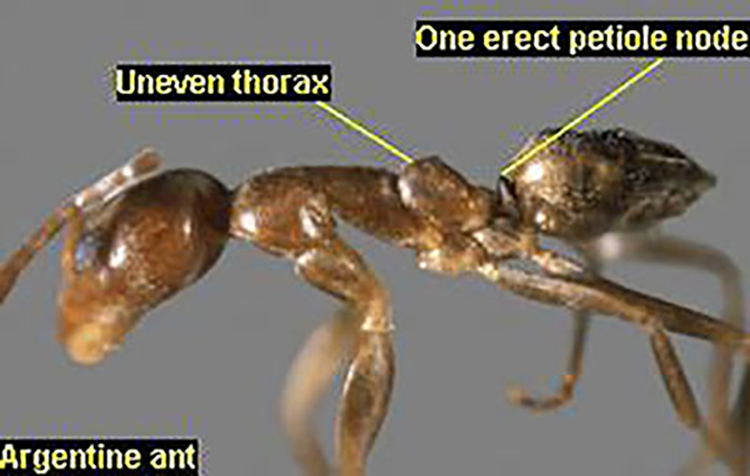
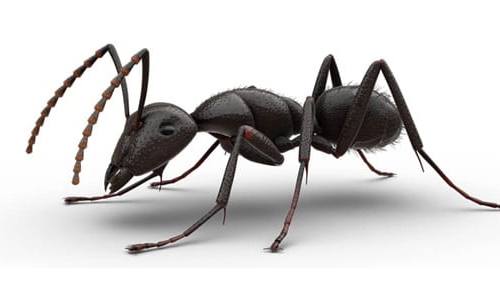
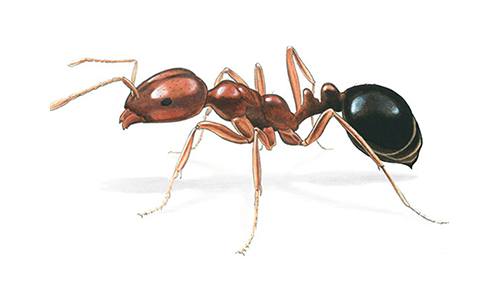
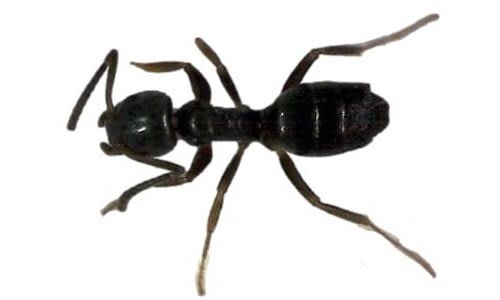
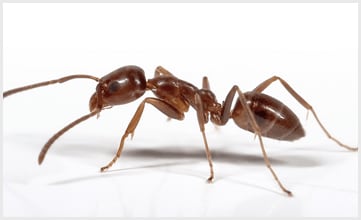
This is a picture of the Argentine worker ant. The Argentine worker ants are the ones most commonly spotted. They are light to dark brown and are about 1/12–1/8-inch long. They have a uniform dull brown color. Their antennae are strongly elbowed (12 segments), and there is a single node in front of the abdomen (the waist). The Argentine ants are one-node ants. The Petiole (the node that separates the thorax from the abdomen) has one erect node. The thorax (middle part supporting the legs) on the Argentine ant has an uneven shape when viewed from the side.
- Workers: About 1/8inch in length
- Queens range from 1/6 to1/4 inches in length.
- Legs are in proportion to the body
Argentine Ants Rarely Nest In Walls
Their usual habitation is outside, but these ants can present a problem when they come inside foraging for food. They rarely nest in walls of buildings, as some other ants commonly do. They enter to feed and then exit, returning to the nest.
You probably won't ever see a winged form of the Argentine ant, because mating is usually accomplished in the nest, not in mating flights. Argentine ants are aggressive, often eliminating other types of ants in the same area. They also destroy and eat other household pests such as cockroaches and exposed termites.
Musty Smell
A musty odor is emitted when the Argentine ant is crushed. The Odorous ant also has a musty smell when crushed and is a one-node ant, but the node shapes are different. The Argentine ant node is pointed, and the abdomen hides the Odorous ant's node. Argentine ants may be confused with the Crazy ants and Small (False) Honey ants. Still, the Crazy ants and Small (False) Honey ants have a circle of hairs at the abdomen's tip, while the Argentine ant does not have hair on the tip of its abdomen.
Abundant in California
Since Fire ants and other competitors are mostly absent in California, this state has seen the Argentine ant thrive in the temperate and damp coastal regions. Argentine ants have killed and displaced native ants, many of which are ten times larger in size.
First Step: Begins with Inspection
Inspect For Ant Nests
- These ants like to nest in moist soil next to buildings or under them, particularly near plants and sidewalks.
- They nest near water and food sources. Sometimes they will nest inside a structure, such as a bathtub set above a slab foundation, under expansion joints on slabs, under insulation in an exterior wall void, and in interior potted plants.
- Foraging ants will enter the house when outside conditions are extremely dry or wet. The foraging worker ants will travel along regular paths from the nest and branch out to explore an area. Their foraging patterns may be so extensive as to incorporate a next-door neighbor's yard.
- Baiting would be the best solution in these cases. Most Argentine ants establish new nests by swarming to mate. These ants mate inside the nest from reproductives produced inside the nest.
- Argentine ants are incredibly mobile and will relocate colonies frequently. They will establish new colonies many times because of many external factors such as food sources, changing temperature, and proximity to woody plants.
- Tracking Argentine ants can be easy because they generate active pheromone trails when foraging. In many areas, you will see pheromone trail super-highways three and four lanes wide.
Second Step: Prevent and Seal Access Points
- As with all insects that may gain access into your home, consider sealing up with caulk any small crack and crevice in the foundation or window areas where outside pests could enter. Get rid of any excess vegetation, such as
- Cut down tree branches near your home. They may serve as a highway into your home to enter.
- Keep tight lids on trash containers and clean up any food particles, particularly sweet foods. Argentine ants are attracted to food and water, so eliminate any standing water such as birdbaths, grill covers, and standing water in flower pots.
- Firewood piles may be ideal nesting sites for Argentine ants, so you may need to remove them.
Argentine Ants Control Using Ant Bait
- The use of residual sprays or dusts stresses ant colonies, causing them to split into sub-colonies and scatter. This scattering, also called budding, multiplies the number of ant colonies and multiplies your ant problem.
- When you bait, use a slow-acting bait. Quick-kill insecticides and baits will only kill the foraging ants, not allowing those worker ants to take the bait back home to feed the queen, nest workers, and brood.
- If the ant bait you are currently using is not effective (if the ants are not visiting the bait), you will need to change the baits. Slow-acting baits provide a variety of the foods the ants find in nature. Examples include other insects (proteins/grease-based baits), nectar, aphid honeydew, and plant products (sugar and carbohydrates found in sweet-based baits).
- Choosing a bait requires an understanding of the nutritional needs of the colony. To be sure that you have all the baiting needs met, you may want to be ready with a sugar/carbohydrate-based bait, and a protein/grease-based bait.
- IMPORTANT NOTE: REMOVE ALL OTHER FOOD COMPETITION WHEN BAITING AND LEAVE THE BAIT ALONE ONCE THE ANTS START FEEDING ON IT.
- Advion Ant Bait- Advion ant bait gel has a highly attractive formulation to be attractive and non-repellent towards all major species of ants, and it works very well against Argentine ants when they are feeding on sugar.
- DominAnt 1% Liquid Ant Bait-DominAnt 1% Liquid Ant Bait is a ready-to-use solution for controlling large, multi-queen, or multi-colony ant infestations.
- Optigard Ant Bait Gel-Optigard Ant Bait Gel is a powerful, slow acting non-repellent ant bait. The active ingredient, thiamethoxam, knocks out workers, brood, and queens. Optigard is for indoor and outdoor control of ants (excluding fire, harvester, and Pharaoh ants). Optigard Ant Bait Gel doesn't have the unsightly yellowish-brown color or the runny inconsistency of other baits.
- Invict Blitz-Invict Blitz is perfect protein based bait for mega-colony ants like Argentine ants. It also works well against Rasberry Crazy, Caribbean, and Big-Headed ants.
Third Step : Argentine Ant Control with Insecticides and Ant Baits
When in doubt of which one to choose, choose one from each category (one from sugar and one from protein-based baits).
- Top recommendation from the protein/grease category is Invict Blitz or Invict Xpress (Invict Blitz can only be sold in FL, GA, LA, and TX)
- Top recommendation from the sweet feeding category is Optigard Ant Bait Gel
The Mega-Colony Ant Kit has Advion Ant Gel, Invict Xpress and Prime Source Imidacloprid 2F combined as a kit, saving money. Use the baits on the inside and outside where you see the ants foraging and use the Imidacloprid 2F- as a spray on the ground and foliage. The Prime Source Imidacloprid 2F-is a non-repellent insecticide that will not cause the ants to scatter.
Argentine Ants Control Using Insecticides
- Unless you use a non-repellent spray, such as Navigator SC or Prime Source Imidacloprid 2F, labeled to spray in the yard and perimeter, baiting is the preferred treatment over typical residual spraying. Navigator SC is for outside perimeter only. The Imidacloprid 2F may be sprayed on the yard and drenched into the nest.
- If you use a typical residual insecticide, you will cause the ants to split and scatter into other areas and cause an increase in the population. One of the characteristics of a non-repellent is that you can spray it without the ants detecting it.
- Baiting is the most reliable way to eliminate the entire colony. When choosing ant baits, it is best to choose from both sugar-based baits and protein/grease-based baits. If using a spray, choose a non-repellent type, unless you are treating the nest itself. If you treat the nest, you would need to apply the drench method.
- The best outside insecticides for Argentine Ant control are non-repellent insecticides such as or Navigator SC, or Imidaclorprid 2F.
- Use Imidaclorprid 2F as both a perimeter treatment and to spray the foliage, turf, flower beds, and ground cover.
- You would spray on the outside with Navigator SC around the perimeter. Usually spraying the perimeter is enough treatment for Argentine Ants, as they will go outside. If you need any insecticide inside, use Sprectre PS Aerosol in cracks and crevices.
- Non-Repellent insecticides are best for ants and termites because these insects can not detect it and will not try to escape the insecticide. Non-repellent insecticides can't be smelled, tasted, or even felt by Argentine Ants.
Another advantage of using a non-repellent insecticide such as Navigator or Spectre PS for Argentine Ant Control is that you can use a good mega ant colony bait, like Invict Blitz with it. Repellent insecticides do not combine well with insect baits, because they contaminate the lures inside the baits; that is not the case with non-repellents.
Key Takeaway
Argentine Ant colonies are large and often have satellite colonies. Patience and persistence are required to gain the upper hand. Don't rely on one product. Often combinations of sprays and baits are necessary. Argentine Ants often travel great distances, so chances are, your neighbors have issues with them too. Coordinating treatments with neighbors can help control these Mega Colony ants. Don't use traditional insecticide sprays. They will cause just colonies to scatter and spread. Use non-repellent sprays like those found in our Mega Colony Ant Kit.
Where Argentine Ants Are Found (Distribution)
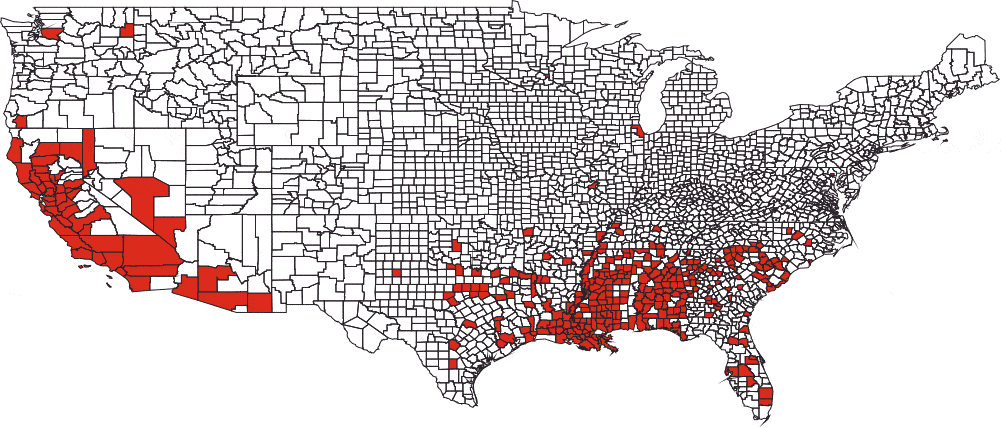
You will find Argentine ants mostly in the southern United States, especially California.
It is generally understood that Argentine ants may have entered the United States aboard ships carrying coffee or sugar from Argentina during the 1890s. They expanded from the coast throughout California and to the southern parts of the United States.
Argentine ants find Fire ants to be fierce competitors, and so Argentine ant populations are not as numerous in the southeastern parts of the United States.
Argentine Ant Life Cycle
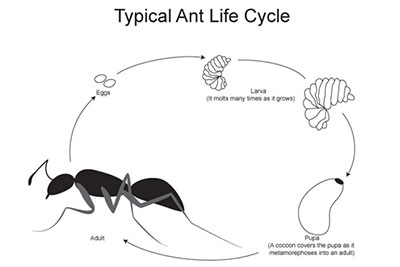
The Argentine winged queen ants can produce fertile eggs for up to 10 years after mating once with a winged male. Another difference in this type of ant compared to other ants is that several productive queens can share the same colony. One or more of these productive queens may leave with some of the workers to form a new colony when it gets crowded (this is known as budding).
Queens lay as many as 60 eggs per day. Development from egg to adult averages 74 days for workers. Worker longevity is 12 months. Argentine queen ants also clean and feed themselves and feed and groom immatures, in addition to laying eggs.
The grub-like larvae are fed and tended by the workers, pupate, and then emerge. to join their sisters in the colony (worker ants are all sterile females). The white eggs are laid in the summer, and the larvae emerge after about 28 days. The larval stage may take from 11–60 days. The pupal period may last from 10–25 days or more. Development from egg to adult usually takes about two months, but may take up to 4–5 months. During the summer months, highly mobile satellite nests are usually established close to food sources.
Survival and Persistence
Argentine ants can live in conditions where other ant species could not survive. Both rural and suburban environments have Argentine ants. Colonies are large (mega colonies), often containing hundreds of queens. These ants are very adaptable. If it is too dry or wet outside, they may enter structures in large numbers. They often use utility lines or overhead tree branches to enter buildings. If they find a food source in your home, you may see these small brown ants in massive numbers. They often are found near sugary foods when they come inside to hunt for food.
Argentine Ant Diet
Argentine ants prefer sweet foods and are often found tending aphids or scale insects on plants, using them as a source of honeydew. Argentine ant workers like sweet foods such as syrup, fruit juices, or plant secretions, but will gather protein/grease-based foods to bring back to the queens and larvae. They gather food day and night. Of all the smaller-sized ants, this one prefers sweet foods more than protein. The queens and larvae eat protein/grease foods (and baits) almost exclusively, while the workers eat sugar-based foods (and baits).
Written by our resident pest control expert Ken Martin.