




How to Get Rid Of Pillbugs and Sowbugs
If you have an active pillbug infestation, follow this guide to learn how to get rid pillbugs and sowbugs.

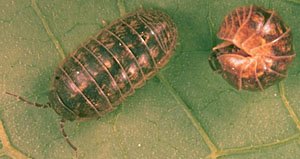
Pillbugs and Sowbugs as pests are more closely related to shrimp and crayfish than insects being of the class Crustacea.
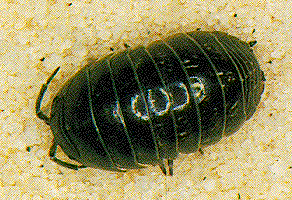
The typical Sowbug has two tail appendages at the tip of the abdomen. The common Pillbug doesn't have the appendages and is capable of rolling into a tight ball. They are often called "rolly-polies".
General Information
- They live outdoors, feeding on decaying organic matter and occasionally young plants and their roots.
- They may be found around flower-bed mulches, grass clippings, leaf litter, rotting boards, trash, rocks, and pet droppings are present.
- Sowbugs and Pillbugs can be found invading damp basements and crawl spaces.
- On a hot day, they remain under objects on the damp ground. They are active only at night due to lower temperatures and more humid conditions.
- Sowbugs and Pillbugs may infest potted plants.
- When the infestation is heavy, it generally indicates a large population immediately outside the building.
- Adequate moisture is essential for their survival and the group in masses to reduce water loss.
- They become inactive during the winter months except in heated structures such as greenhouses.
How To Get Rid of Pillbugs/Sowbugs
Residual Liquid Insecticides
Repeat treatments of these suggested liquid residual insecticides every 3 months.
- Avesta CS- (Broader label and longer lasting-may be used inside or outside and will dry invisible. Avesta CS has no or very little smell. Avesta CS will last longer outside and adhere to the surface better due to its encapsulated technology. Avesta 8 oz will yield 16 gallons.
- Cyper WSP Comes in a water-soluble packets for mixing convenience. It has long-lasting control like the Avesta CS, but will leave a visible residue.
Aerosols
Use an aerosol like Micro Care Aerosol Micro Care Pyrethrum or Alpine Aerosol PT, sprayed around doors and windows and other places where these pests may enter premises. This aerosol comes with a crack and crevice tip enabling you to spray into the smallest cracks and crevices.
- Repeat treatment of this aerosol once a month.
Granules
Bifen LP Granules would be an additional treatment around the house to serve as a barrier against pillbugs or sowbugs. The advantage of granule treatments in addition to liquid residual barriers is that they hold up under rainfall.
- Repeat treatments of granules every 3 months
Use professional residual insecticides recommended in this article. Spray the insecticide along entry points, cracks-crevices, and along baseboards. Even more useful would be an excellent residual sprayed outside as a perimeter treatment along the exterior foundational walls.
Spray a perimeter treatment about 3 feet along the foundation and 3 ft. up the exterior wall. Also spray around the entry points like doors and windows.
Prevent Pillbugs/Sowbugs
- Prevention begins outdoors by removing harbor aging places that hold moisture. These places include wood debris, rocks, grass clippings, leaf litter, and other debris from the foundation walls, doors, basement windows, and other entry points.
- Firewood should be stored off the ground.
- Lawns should be watered in the morning to promote drying by the afternoon.
- Flower beds should not be over mulched.
- Properly ventilate basements and subfloor crawl spaces to eliminate excess moisture.
- Repair and seal cracks and openings in the foundation wall, around doors, and basement windows with caulking compound and weather stripping.
- Drain standing water and moist areas near potential points of entry.