




How to Get Rid of Powder Post Beetles
Learn how to get rid of powderpost beetles and prevent wood-boring beetles infestation with our tips and recommendations.
December 16th, 2023
How to Get Rid of Powderpost Beetles
The first thing to do when attempting to get rid of powderpost beetles is to reduce the wood's moisture content to less than 20%. Moisture meters can be used to determine the moisture level in the wood.
Central heat, vapor barriers, and adequate ventilation can also help control moisture and eliminate powderpost beetles. Rough-cut lumber should be dried in a kiln to kill all stages of the beetle. Reducing moisture may not be enough to get rid of powderpost beetle infestations completely.
Sanded and varnished wood will not be as attractive to adult powderpost beetles. They can not penetrate or find cracks and crevices in the wood surface to deposit their eggs.
Don't store valuable items in sheds and barns. Wood-boring beetles are common in these areas.
Infested furniture made of unfinished wood (unvarnished, not painted, not waxed, or not sealed) can be treated with Tim-bor or Boracare. Boracare and Timbor will prevent newly hatched powderpost beetle larvae from entering the wood. Infested furniture that can not be treated with a product like Tim-bor and Boracare can be treated in fumigation chambers. Fumigation chambers are used to fumigate infested furniture. Look for pest control operators that are licensed for fumigations.
If practical, remove infested wood. If not, use residual borate insecticides such as Boracare or Timbor. Due to its long life cycle (12-18) months in the wood, you may see emerging powderpost beetles emerge even after treatment. The eggs and coming larvae will come in contact with the insecticide to kill them.
Recommended Borate Insecticides to Get Rid of Powderpost Beetles
1. Timbor Powder Post Beetle Killer
Timbor Professional Insecticide for powderpost beetle treatment is an insecticide powder that mixes with water. One l.5 lbs pouch is mixed with one gallon of water and sprayed to the infestation surface area. When sprayed, it penetrates the entire wood, where it will remain for several years.
2. Use Boracare to Get Rid of Powderpost Beetles
An alternative to Timbor is Boracare. Boracare is a liquid borate that penetrates faster initially than Timbor for the first few hours but is equal after that. Timbor is considerably cheaper per gallon to use.
3. Get Rid of Powderpost Beetles with Fumigation
Fumigation may be advisable in severe powder-post beetle damage cases, mostly where other methods have failed or where the insects' rapid elimination is critical or desired. Fumigating is advantageous where it is hard to apply borate treatments such as cramped crawlspaces. A certified pest control operator must do fumigation with a fumigation license. Fumigation is non-residual and will not last. Because of this, fumigation will not prevent future re-infestation if the wood is exposed to adult powderpost beetles looking to lay their eggs.
Alternatives to fumigation describe the benefits and drawbacks of borate liquid insecticides instead of fumigation.
Note When Using Insecticides to Get Rid of Powder Post Beetles
Powderpost beetles' life cycles vary from 3 months to several years. Emerging larvae could be maturing, with adult beetles emerging for several years. If the wood is too dry (less than 15%), penetration depth with the Boracare may only occur to the top 1/4 inch. To solve this, spray the wood first with water to increase moisture.
Identify
Adult Powderpost Beetles do little damage to wood structures, it is the larvae (woodworms) that do most of the damage. They go through a complete metamorphosis: adults, eggs, larvae, and pupae. You can easily recognize the work of powderpost beetles.
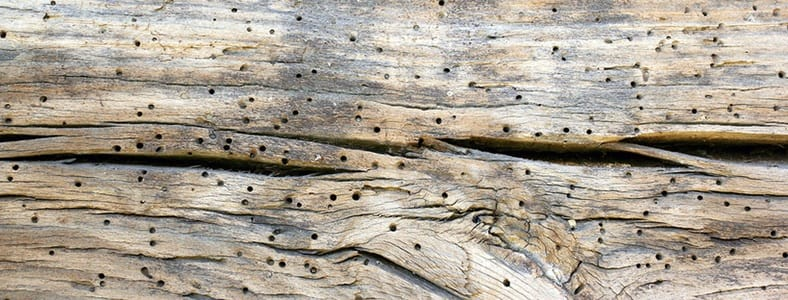
When the adults emerge, usually in June, some species leave small holes about the size of a pin on the wood's surface; others make holes the size of pencil lead. Fine and powder-like, a brood of larvae (woodworm) carry on their destructive feeding from these holes.
Usually, these insects have a 1-year life cycle; this means that the adults will appear only once each year. And because of this habit, the larvae have a feeding period of many months.
Powderpost Beetle Identification
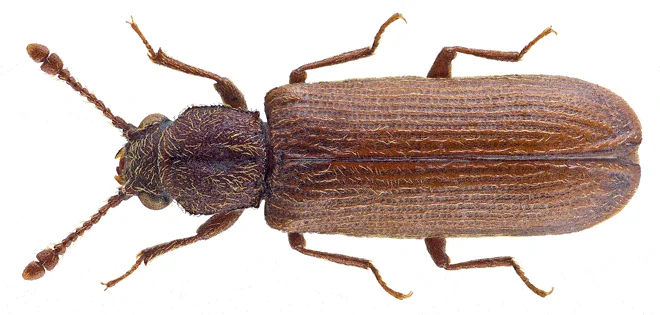
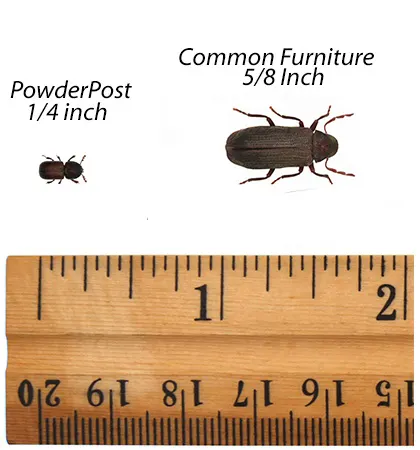
The adult powderpost beetles are tiny, less than 1/4" in size, cylindrical, and reddish-brown to black. The adults bore into the wood to lay eggs, leaving a hole larger than 1/8 inch, usually in wood less than ten years old.
Larvae (woodworm) are white and cream-colored, shaped with dark brown heads. Larvae create tunnels in the wood and become pupae.
The larvae are curved and wrinkled. Their diet is dependent on the starch in the wood; they are more common in softwood but can attack hardwoods. They require 6-30% moisture content in the wood and complete the average life cycle in one year.
Biology, Diet, and Habitations
The diet of these beetles is sugar, starch, and protein found in the sapwood of hardwood. They attack woods with high moisture. The moisture content of less than 6% is ideal for keeping these beetles from attacking.
In the United States, the True Powderpost Beetle is the most common. They are often found in structures that have been built from infested lumber. They can re-infest if you do not kill powderpost beetles correctly.
How to Inspect for Powderpost Beetles
You need to determine if the infestation is active before initiating treatment to get rid of powderpost beetles.
Spotting Infested Wood
Wood in structures and furniture infested by these beetles may go unnoticed until the round adult emergence holes appear on the surface. The characteristic pellets found in the frass and the consistency of the frass are useful in determining what species are infesting the wood. Infested wood can be removed and replaced with treated wood. Reducing the wood moisture content to approximately 12% slows the development of the larvae.
The surface of unpainted or otherwise unprotected wood can be treated by injecting the galleries with disodium octaborate tetrahydrate such as BoraCare or Timbor.
These products kill exposed larvae and prevent re-infestation when the eggs hatch and immature larvae begin to penetrate the wood. However, the most effective way to get rid of powderpost beetle infestations is to fumigate using sulfur fluoride or methyl bromide.
The surface of unpainted or otherwise unprotected wood can be treated by injecting the galleries with disodium octaborate tetrahydrate such as BoraCare or Timbor.
These products kill exposed larvae and prevent re-infestation when the eggs hatch and immature larvae begin to penetrate the wood. However, the most effective way to get rid of powderpost beetle infestations is to fumigate using sulfur fluoride or methyl bromide.
Wood-boring beetles damage
The first step to management is deciding if there is an active infestation. If you spot powderpost beetle damage, you may be inspecting old damage.
An active infestation will have borings in piles accumulated on the floor below or near the holes. You may also hear a ticking sound made by the larvae. If the damage is old and not currently active, you do not have to treat it.
Inspect all exposed wood surfaces periodically and probe them for evidence of internal damage. Evidence of attack is more common in attics, crawl spaces, unfinished basements, and storage areas.
Again, make sure that the infestation is active (not old damage or old frass). There should be fresh frass the color of newly sawed wood or live larvae or adults in the wood.
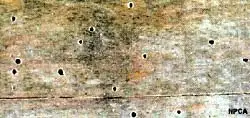
Powderpost beetle damage
The presence of extremely fine, flour-like powder falling from the surface holes is a good indicator of a powderpost beetle infestation.
The frass left by other wood borers usually contains pellets. This type of beetle frass has a coarse texture and a tendency to stick together.
Recently formed holes and frass (sawdust-like) are light in color and clear in appearance; old holes and frass are dark in color. If the damage you find is an active infestation, we have listed the best ways to get rid of powderpost beetles below.
Areas of Attack and Damage
Powderpost beetles attack hardwoods when depositing their eggs. True Powder Powderpost Beetles breed in dead and dried hardwoods such as trees' dead branches and limbs. Their presence is overlooked until discovered in stored lumber, rafters, joists, finished wood, and furniture products.
Many times the Powderpost Beetle (Lyctidae) enters lumber that is stored or cured. It later emerges afterward. These beetles frequently attack old wood antiques. Hardwood floors such as ash, hickory, oak, walnut, and cherry are frequently attacked. These hardwoods that are damaged have starch-rich sapwood and are large-pored.
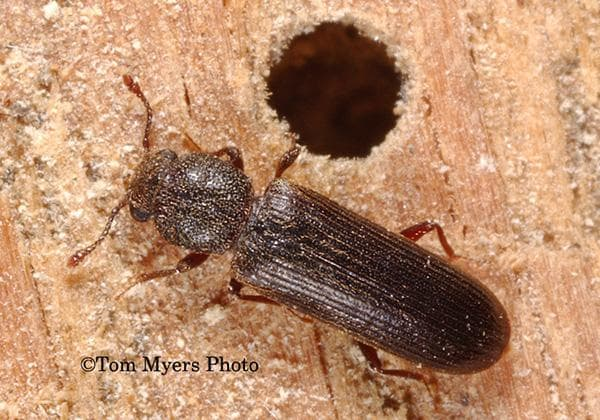
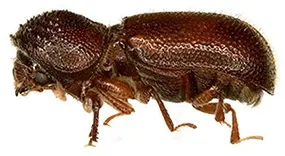
Since the False Powderpost Beetles are larger than other families of powderpost beetles, their exit holes are larger. These holes do not contain frass, but the galleries contain the frass. The frass is tightly packed, tends to stick together, and is mealy (contains no pellets).
The good news for homeowners with hardwood floors is that most of the hardwoods attacked are not commonly used for interior floors, woodwork, or trim. Most of this species does not reinfest wood after it is seasoned, so the damage is limited to that inflicted by one generation. However, the speed of the damage can be considerable.
Powderpost beetles are often found in oak, firewood, and furniture.
The Four Types of Powderpost Beetles
This section will discuss four types of Powderpost beetles in four families: Lyctidae, Bostrichidae, Anobiidae, and Cerambycidae.
We will teach you how to identify and get rid of powderpost beetles of the species listed below:
-
Deathwatch Beetle
-
Furniture Beetles
-
Long-Horned Beetles
-
Old House Borer Beetles
1. Deathwatch Beetle
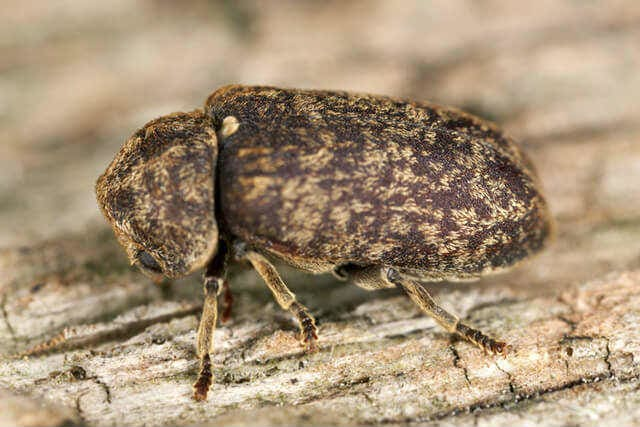
The adult deathwatch beetle, Xestobium rufovillosum, is 1/4 to 3/8 inches long and is gray-brown with patches of pale hairs on the body's back.
The Death-watch beetle is found throughout the United States. It attacks building timbers in poorly ventilated areas where moisture tends to collect. These beetles are heard at night, making an audible ticking sound. It picked up the nickname "Deathwatch" from this behavior.
This insect is a common pest in crawl space timbers located in the southeastern United States. Powderpost beetle infestations can become so severe that they cause loss of structural strength to sills and joists. Various anobiid beetles attack seasoned wood in the United States.
The first body segment (pronotum) is hood-like, hiding the head when viewed from above. The last three segments of the antenna are lengthened and expanded into a club.
-
It does not have rows of pits on the wing covers, and its 11-segmented antenna ends in three elongated segments that are as long as the previous five segments.
-
The last three segments of the antenna are longer than the first eight combined.
-
The powder post beetle larvae form tunnels in both softwoods and hardwoods. They require 13-30% moisture content.
-
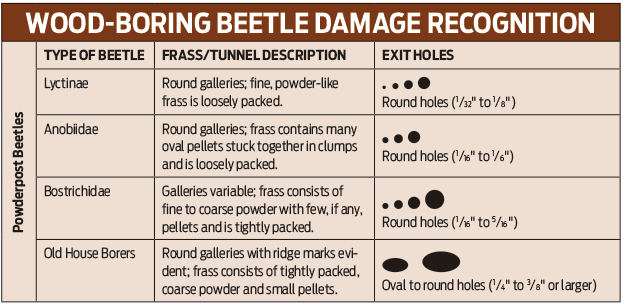
Their holes are round 1/16-1/8 inches. They can digest cellulose from the wood. They are inclined to the softwoods; for this reason, they are common in crawl spaces and basements infesting the pine used as framing lumber.
-
The powder outside the holes (frass) is fine to coarse, many times with small pellets. The life cycle averages 1-3 years.
-
They commonly re-infest crawl space areas that are poorly ventilated, and humidity is absorbed in the wood.
2. Furniture Beetles
The furniture beetle is found mostly in the eastern half of the United States. Furniture beetle adults emerge in the spring from cells just below the surface of the infested wood. Soon afterward, mating occurs, and egg-laying begins.
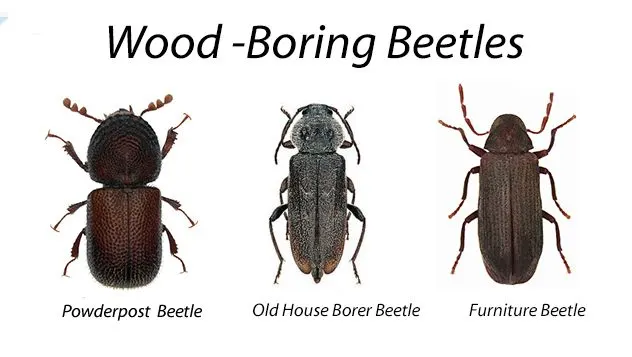
The female beetles lay 20-60 eggs in old emergence holes or cracks and in the wood—eggs hatch in six to 10 days. The larvae feed for about one year before pupating for two to three weeks. The wood moisture content required for larval development is 13-30%.
When development is complete, the adult powderpost beetle bores directly to the wood's surface, emerging through a round hole 1/16 to 1/8 inch in diameter. Development under ideal conditions can be completed in one year; however, two to three years are common.
The adults are active at night. Some species are attracted to light.
Powderpost beetles commonly infest seasoned sapwood of hardwoods and softwoods. They attack structural timbers, lumber, cabinets, and furniture. These beetles reinfest and the female beetles usually lay eggs in the wood from which they emerged. The larvae typically follow the grain of the wood when feeding ad fill their tunnels with wood frass. The frass is a fine powder with long pellets loosely packed into the galleries.
3. Long-Horned Beetles or Round-Headed Borers
Most representatives of this family infest and feed on dead or dying trees. However, many feed on living trees. Some of these species begin their development in dying trees, logs, or unseasoned lumber and then complete the development as the wood seasons.
This family's beetles lay their eggs in cracks or crevices in the bark or on the surface of rough-sawn timbers. The larvae are wood borers. A sighting of these beetles can lead to a false assumption of a structural attack.
A common source for these beetles indoors is firewood brought indoors. Firewood that is brought in should be used soon after it is brought inside to avoid powderpost beetles.
Mature larvae are large, varying from 1/2 to 3-4 inches long. The body is long and narrow and a light cream color. The rear portion of the head is partly drawn into the body. Only the mandibles and other mouthparts are easily seen.
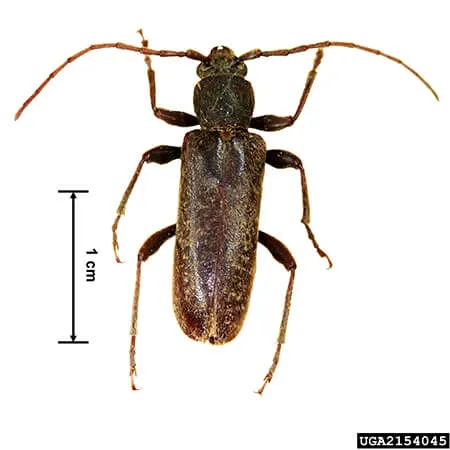
Adults vary in size from 1/2 inch to 3 inches long. They can be easily distinguished from other beetles by their long, thin antennae, which may be longer than the body; hence the adults are called long-horned beetles. The adults of these Borer beetles will emerge from the wood after it has been incorporated into the structure. They will not re-infest the wood because of its dryness.
4. Old House Borers Beetles
The Old House Borer is one of the most common in the powderpost beetle family. Its larvae hollow out galleries in seasoned softwood(pine). It is found in older buildings but is more frequent in newer buildings (in houses less than ten years old). The powderpost beetle is well established along the Atlantic Coast, but infestations have been reported as far as Louisiana and Minnesota.
The adult powderpost beetles are brownish-black to black, slightly flattened, and about 3/4 - 1 inch long. The life cycle of the old house borer ranges between three to twelve years. The exit holes of emerging adults do not occur in large numbers until the infestation has been established for several years.
Because the powderpost beetle has a very long life cycle, it can re-infest the same pieces of wood for years. It may be many years before severe structural damage is recognized, so it's crucial to kill powderpost beetles like this one as soon as you notice them.
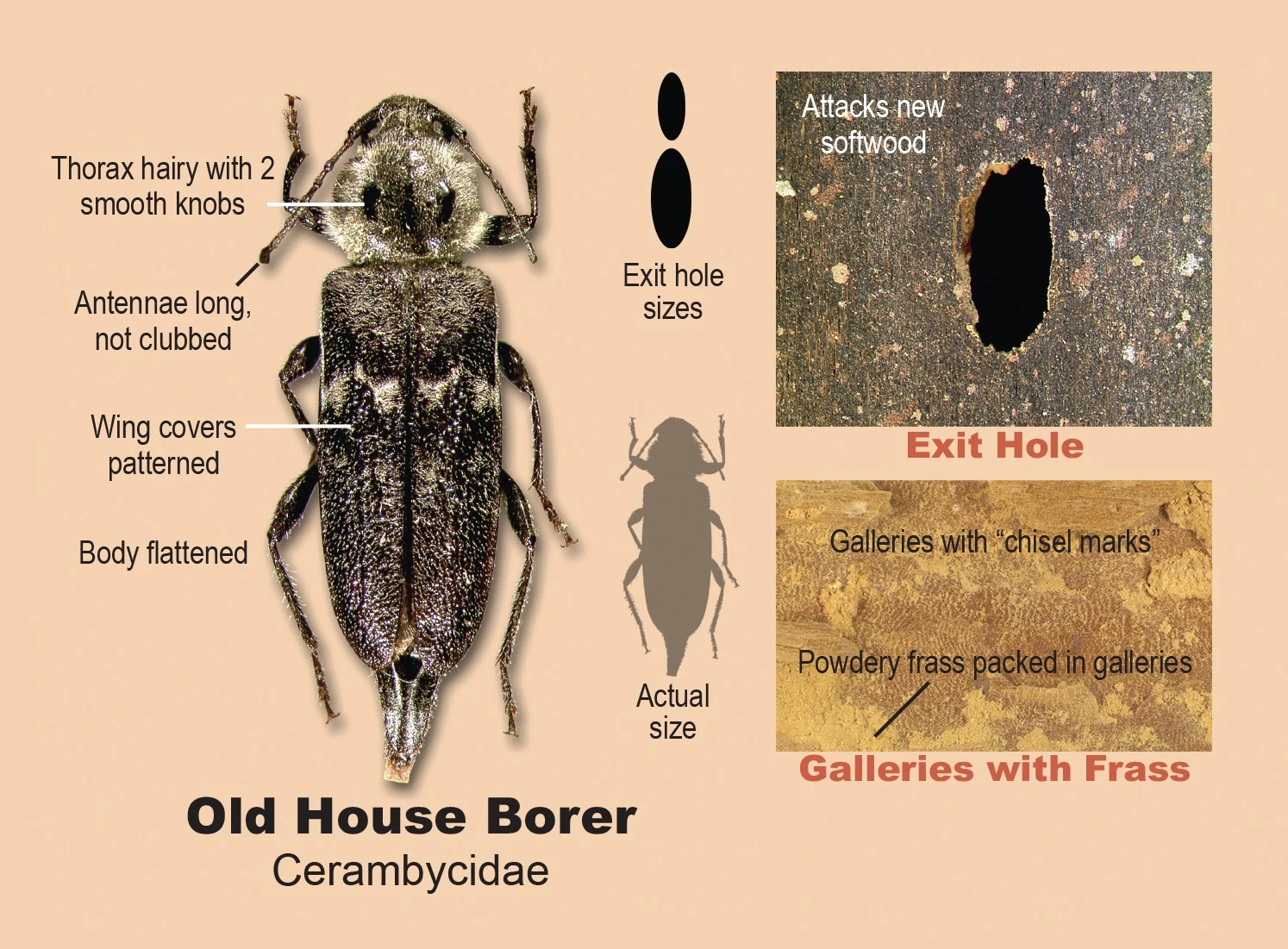
A long life cycle, paired with the fact that powderpost beetle larvae do extensive feeding without breaking through the wood's surface, means that you need to inspect beetle infested wood very carefully to detect old house borer damage.
Rough wood being examined should be probed or struck to detect weakness or the presence of boring dust. If exit holes are present, they will be broadly oval and about 1/4-3/8 inch in diameter. When wood has been infested with fungi, powderpost beetle larval development is faster. Their powder (frass) in the tunnels is like sawdust, tightly packed.
Prevention of Wood Boring Beetles
Most of the procedures that prevent wood infestations are completed before you purchase it, it is the responsibility of those who harvest, mill, or treat the wood. However, those who use wood should take precautions to reduce the chances of infestation in structures and furniture. Using these preventative measures will make it easier to eliminate powderpost beetles in the future.
Steps to prevent beetles from infesting wood include:
-
Inspecting wood for powderpost beetles before purchase
-
Using a kiln or air-dried timber properly.
-
Sealing wood surfaces
-
Using chemically treated wood (wood preservatives or insecticides).
-
Using good building design such as ventilation, drainage, and proper clearance between wood and soil will reduce the moisture content. These precautions would create less favorable conditions for beetle development.
-
Central heating and cooling systems also speed up the wood drying process.
How to Get Rid of Powderpost Beetles
Learn how to get rid of powderpost beetles and prevent wood-boring beetles infestation with our tips and recommendations

How to Get Rid of Powderpost Beetles
- The first thing to do in powderpost beetle treatment is to reduce the wood's moisture content to less than 20% moisture. Moisture meters can be used to determine the moisture level in the wood. Central heat, vapor barriers, and adequate ventilation can help control moisture. Rough-cut lumber should be dried in a kiln to kill all stages of the beetle. Reducing moisture may not be enough to control powder post beetle infestations completely.
- Sanded and varnished wood will not be as attractive to adult powderpost beetles. They can not penetrate or find cracks and crevices in the wood surface to deposit their eggs.
- Don't store valuable items in sheds and barns. Wood-boring beetles are common in these areas.
- Infested furniture unfinished (unvarnished, not painted, not waxed, or not sealed) can be treated with Tim-bor or Boracare. Boracare and Timbor will prevent newly hatched larvae from entering the wood. Infested furniture that can not be treated with a product like Tim-bor and Boracare can be treated in fumigation chambers. Fumigation chambers are used to fumigate infested furniture. Look for pest control operators that are licensed for fumigations.
- If practical, remove infested wood. If not, use residual borate insecticides such as Boracare or Timbor. Due to its long life cycle (12-18) months in the wood, you may see emerging beetles emerge even after treatment. The eggs and coming larvae will come in contact with the insecticide to kill them.
- Recommended Borate insecticides for powderpost beetle treatments :
- Timbor is a powder that mixes with water. One l.5 lbs pouch is mixed with one gallon of water and sprayed to the infestation surface area. When sprayed, it penetrates the entire wood, where it will remain for several years.
- An alternative to Timbor is Boracare. Boracare is a liquid borate that penetrates faster initially than Timbor for the first few hours but is equal after that. Timbor is considerably cheaper per gallon to use.
- Note when using insecticides: Powderpost beetles' life cycles vary from 3 months to a year. Emerging larvae could be maturing, with adult beetles emerging for up to a year. If the wood is too dry (less than 15%), penetration depth with the Boracare may only occur to the top 1/4 inch. To solve this, spray the wood first with water to increase moisture.
- Fumigation may be advisable in severe powder-post beetle damage cases, mostly where other methods have failed or where the insects' rapid elimination is critical or desired. Fumigating is advantageous where it is hard to apply borate treatments such as cramped crawlspaces. A certified pest control operator must do fumigation with a fumigation license. Fumigation is non-residual and will not last. Because of this, fumigation will not prevent future re-infestation if the wood is exposed to adult powder post beetles looking to lay their eggs.
- Alternatives to fumigation describe the benefits and drawbacks of borate liquid insecticides instead of fumigation.
How to Identify and Inspect Powderpost Beetles


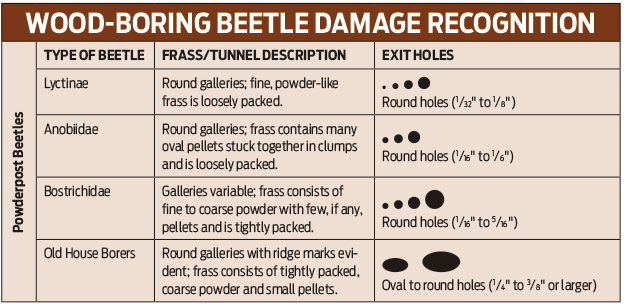
- The first step to management is deciding if there is an active infestation. You may be inspecting old damage. An active infestation will have borings in piles accumulated on the floor below or near the holes. You may also hear a ticking sound made by the larvae. If the damage is old and not currently active, you do not have to treat it.
- Inspect all exposed wood surfaces periodically and probe them for evidence of internal damage. Evidence of attack is more common in attics, crawl spaces, unfinished basements, and storage areas.
- Again, make sure that the infestation is active (not old damage or old frass). There should be fresh frass the color of newly sawed wood or live larvae or adults in the wood.
- Photos courtesy of IPM Alabama
True Powderpost Beetles(Lyctidae)

Powderpost beetle damage
- Presence of extremely fine, flour-like powder falling from the surface holes (see picture below).
- The frass left by other wood borers usually contains pellets. This type of beetle frass has a coarse texture and a tendency to stick together.
- When inspecting the damage, be sure to distinguish old damage from active beetle infestations.]
- Recently formed holes and frass(sawdust-like) are light in color and clear in appearance; old holes and frass are dark in color.
Identification
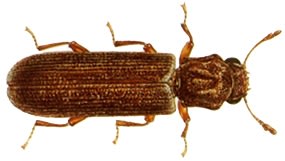
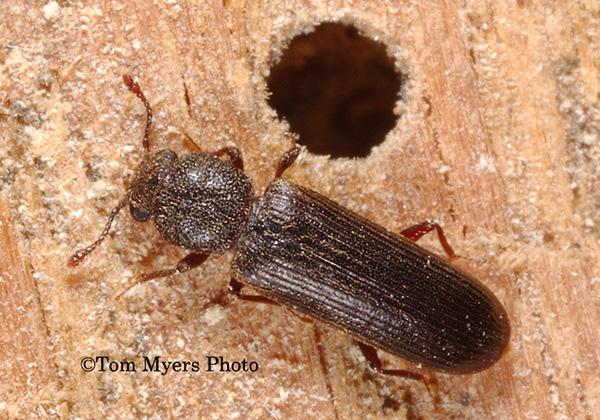
The adults are tiny, less than 1/4" in size. They are flattened and reddish-brown to black in color. Larvae (woodworm)are white and cream-colored, shaped with dark brown heads. Larvae create tunnels in the wood and become pupae. As adults, they bore out through the wood, pushing fine powdery dust out. The shape of their holes is round about 1/32-1/16 pinholes.
Biology, Diet, and Habitations
The diet of these beetles is sugar, starch, and protein found in the sapwood of hardwood. They attack woods with high moisture. The moisture content of less than 6% is ideal for keeping these beetles from attacking. In the United States, the True Powderpost Beetle is the most common. They are often found in structures that have been built from infested lumber. They can re-infest.
Areas of Attack and Damage
They attack hardwoods depositing their eggs. True Powder Powderpost Beetles breed in dead and dried hardwoods such as trees' dead branches and limbs. Their presence is overlooked until discovered in stored lumber, rafters, joists, finished wood, and furniture products.
- Many times the Powderpost Beetle (Lyctidae) enters lumber that is stored or cured. It later emerges afterward. These beetles frequently attack old wood antiques. Hardwood floors such as ash, hickory, oak, walnut, and cherry are frequently attacked. These hardwoods that are damaged have starch-rich sapwood and are large-pored.
False Powderpost Beetle(Bostrichidae)

Since the False Powderpost Beetles are larger than other families of powderpost beetles, their exit holes are larger. These holes do not contain frass, but the galleries contain the frass. The frass is tightly packed, tends to stick together, and is a meal like ( contains no pellets).
The adults are 1/8-to 1-inch long, cylindrical, and reddish-brown to black. The adults bore into the wood to lay eggs, leaving a hole larger than 1/8 inch, usually in wood less than ten years old.
The larvae are curved and wrinkled. Their diet is dependent on the starch in the wood; they are more common in softwood but can attack hardwoods. They require 6-30% moisture content in the wood and complete the average life cycle in one year.
Most of the hardwoods attacked are not commonly used for interior floors, woodwork, or trim. Most of this species does not reinfest wood after it is seasoned, so the damage is limited to that inflicted by one generation. However, the speed of the damage can be considerable.
They are often found in oak, firewood, and furniture.

Picture from International Association of Certified Home Inspectors, Inc.
Since the False Powderpost Beetles are larger than other families of powderpost beetles, their exit holes are larger. These holes do not contain frass, but the galleries contain the frass. The frass is tightly packed, tends to stick together, and is a meal like( contains no pellets). The adults are 1/8-to 1-inch long, cylindrical, and reddish-brown to black. The adults bore into the wood to lay eggs, leaving a hole larger than 1/8 inch, usually in wood less than ten years old. The larvae are curved and wrinkled. Their diet is dependent on the starch in the wood; they are more common in softwood but can attack hardwoods. They require 6-30% moisture content in the wood and complete the average life cycle in one year. Most of the hardwoods attacked are not commonly used for interior floors, woodwork, or trim. Most of this species does not re-infest wood after it is seasoned, so the damage is limited to that inflicted by one generation. However, the speed of the damage can be considerable. They are often found in oak, firewood, and furniture.

Old House Borer Damage (Emergent holes that they leave in the wood) You may see these holes in hardwood floors, wood planks, wood beams, or furniture, even without the beetles' visibility.
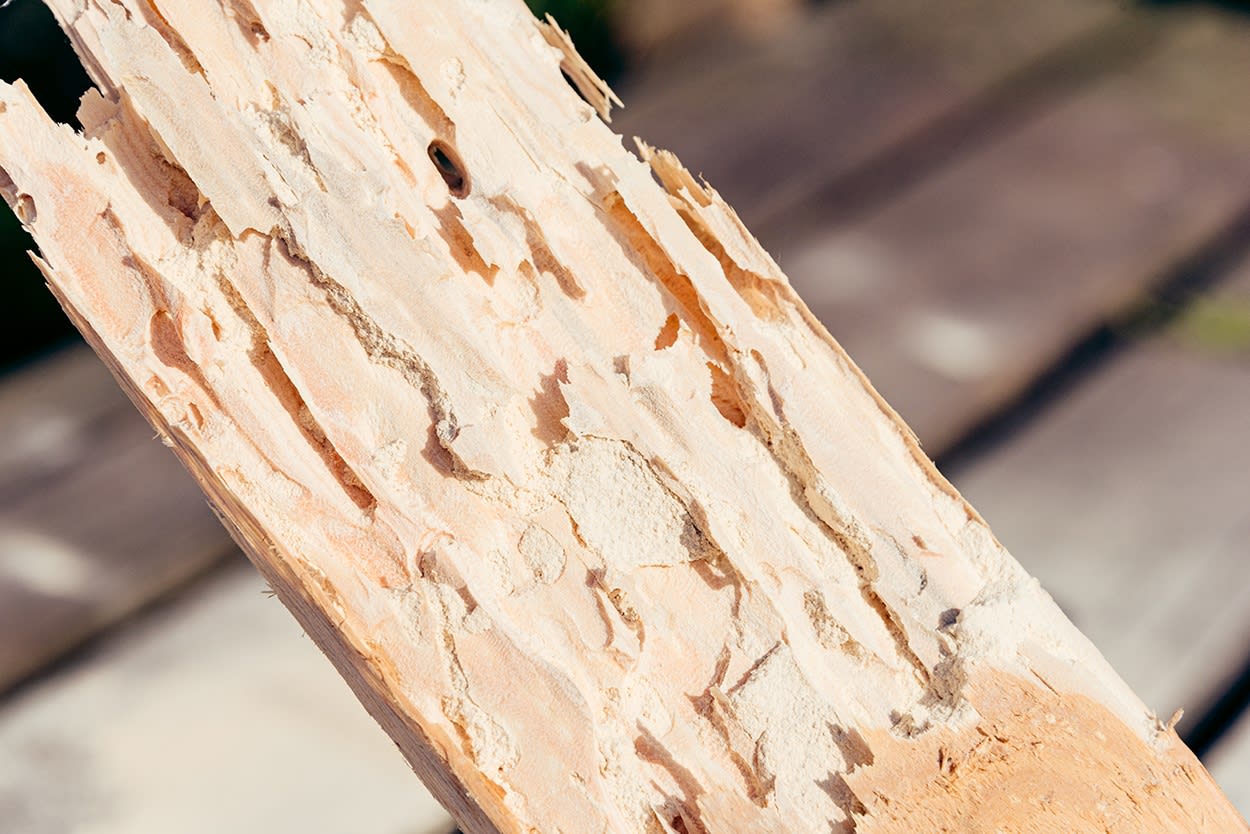
The powder post beetles reduce the wood to a fine like powder(frass).


Anobiidae Powderpost Beetle (Anobiidae)- Furniture and Deathwatch Beetles
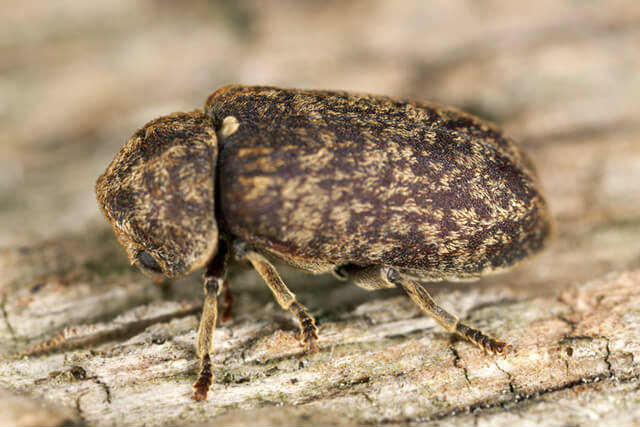
The furniture beetle is found mostly in the eastern half of the United States. It infests structural timbers as well. The Death-watch beetle is found throughout the United States. It attacks building timbers in poorly ventilated areas where moisture tends to collect. These beetles are heard at night, making an audible ticking sound. It picked up the nickname "Deathwatch" from this behavior. This insect is a common pest in crawl space timbers located in the southeastern United States. Infestations can become so severe that loss of structural strength to sills and joists. Various anobiid beetles attack seasoned wood in the United States. These beetles range in size from 1/32- to 3/8-inch long; however, those that attack structures are 1/8- to 1/4-inch long. They have highly variable body forms, but most are elongate and cylindrical. The first body segment (pronotum) is hood-like, hiding the head when viewed from above. The last three segments of the antenna are lengthened and expanded into a club. The furniture beetle, Anobium punctatum, is 1/8- to 1/4-inch long, cylindrical, and red-brown to dark brown. It has a series of pits in rows that run lengthwise on the wing covers. The pits can be seen through the fine yellow hairs that cover the body. The last three segments of the antenna are longer than the first eight combined.
Deathwatch Beetle
The adult deathwatch beetle, Xestobium rufovillosum, is 1/4- to 3/8-inch long and is gray-brown with patches of pale hairs on the body's back.
- It does not have the rows of pits on the wing covers, and its 11-segmented antenna ends in three elongated segments that are as long as the previous five segments.
- The larvae form tunnels in both softwoods and hardwoods. They require 13-30% moisture content.
- Their holes are round,1/16-1/8 inches. They can digest cellulose from the wood. They are inclined to the softwoods; for this reason, they are common in crawl spaces and basements infesting the pine used as framing lumber.
- The powder outside the holes (frass) is fine to coarse, many times with small pellets. The life cycle averages 1-3 years.
- They commonly re-infest crawl space areas that are poorly ventilated, and humidity is absorbed in the wood.
Furniture Beetles
Furniture beetle adults emerge in the spring from cells just below the surface of the infested wood. Soon afterward, mating occurs, and egg-laying begins. The female lays 20-60 eggs in old emergence holes or cracks and v in the wood—eggs hatch in six to 10 days. The larvae feed for about one year before pupating for two to three weeks. The wood moisture content required for larval development is 13-30%. When development is complete, the adult bores directly to the wood's surface, emerging through a round hole 1/16- to 1/8-inch in diameter. Development under ideal conditions can be completed in one year; however, two to three years are common.
The adults are active at night. Some species are attracted to light.
These beetles commonly infest seasoned sapwood of hardwoods and softwoods. They attack structural timbers, lumber, cabinets, and furniture. These beetles reinfest and the females usually lay eggs in the wood from which they emerged. The larvae typically follow the grain of the wood when feeding ad fill their tunnels with wood frass. The frass is a fine powder with long pellets loosely packed into the galleries.
Determine if the infestation is active before initiating treatment. Wood in structures and furniture infested by these beetles may go unnoticed until the round adult emergence holes appear on the surface. The characteristic pellets found in the frass and the consistency of the frass are useful in determining what species are infesting the wood. Infested wood can be removed and replaced with treated wood. Reducing the wood moisture content to approximately 12% slows the development of the larvae.
- The surface of unpainted or otherwise unprotected wood can be treated by injecting the galleries with disodium octaborate tetrahydrate such as BoraCare or Timbor. These products kill exposed larvae and prevent re-infestation when the eggs hatch and immature larvae begin to penetrate the wood. However, the most effective way to eliminate anobiid powder post beetle infestations is to fumigate using sulfur fluoride or methyl bromide.
Deathwatch Beetle
The adult deathwatch beetle, Xestobium rufovillosum, is 1/4- to 3/8-inch long and is gray-brown with patches of pale hairs on the body's back.
- It does not have the rows of pits on the wing covers, and its 11-segmented antenna ends in three elongated segments that are as long as the previous five segments.
- The larvae form tunnels in both softwoods and hardwoods. They require 13-30% moisture content.
- Their holes are round,1/16-1/8 inches. They can digest cellulose from the wood. They are inclined to the softwoods; for this reason, they are common in crawl spaces and basements infesting the pine used as framing lumber.
- The powder outside the holes (frass) is fine to coarse, many times with small pellets. The life cycle averages 1-3 years.
- They commonly re-infest crawl space areas that are poorly ventilated, and humidity is absorbed in the wood.
Furniture Beetles
Furniture beetle adults emerge in the spring from cells just below the surface of the infested wood. Soon afterward, mating occurs, and egg-laying begins. The female lays 20-60 eggs in old emergence holes or cracks and v in the wood—eggs hatch in six to 10 days. The larvae feed for about one year before pupating for two to three weeks. The wood moisture content required for larval development is 13-30%. When development is complete, the adult bores directly to the wood's surface, emerging through a round hole 1/16- to 1/8-inch in diameter. Development under ideal conditions can be completed in one year; however, two to three years are common.
The adults are active at night. Some species are attracted to light.
These beetles commonly infest seasoned sapwood of hardwoods and softwoods. They attack structural timbers, lumber, cabinets, and furniture. These beetles reinfest and the females usually lay eggs in the wood from which they emerged. The larvae typically follow the grain of the wood when feeding ad fill their tunnels with wood frass. The frass is a fine powder with long pellets loosely packed into the galleries.
Determine if the infestation is active before initiating treatment. Wood in structures and furniture infested by these beetles may go unnoticed until the round adult emergence holes appear on the surface. The characteristic pellets found in the frass and the consistency of the frass are useful in determining what species are infesting the wood. Infested wood can be removed and replaced with treated wood. Reducing the wood moisture content to approximately 12% slows the development of the larvae.
- The surface of unpainted or otherwise unprotected wood can be treated by injecting the galleries with disodium octaborate tetrahydrate such as BoraCare or Timbor. These products kill exposed larvae and prevent re-infestation when the eggs hatch and immature larvae begin to penetrate the wood. However, the most effective way to eliminate anobiid powder post beetle infestations is to fumigate using sulfur fluoride or methyl bromide.
Long-Horned Beetles or Round-Headed Borers (Family Cerambycidae)

Most representatives of this family infest and feed on dead or dying trees. However, many feed on living trees. Some of these species begin their development in dying trees, logs, or unseasoned lumber and then complete the development as the wood seasons.A common source for these beetles indoors is from firewood brought indoors. A sighting of these beetles can lead to a false assumption of a structural attack. Firewood that is brought in should be used very soon after it is brought inside. This family's beetles lay their eggs in cracks or crevices in the bark or on the surface of rough sawn timbers. The larvae are wood borers.
Mature larvae are large, varying from 1/2 to 3-4 inches long. The body is long and narrow and a light cream color. The rear portion of the head is partly drawn into the body. Only the mandibles and other mouthparts are easily seen.
Adults vary in size from 1/2 inch to 3 inches long. They can be easily distinguished from other beetles by their long, thin antennae, which may be longer than the body; hence the adults are called long-horned beetles. The adults of these Boers will emerge from the wood after it has been incorporated into the structure. They will not re-infest the wood because of its dryness. Still, they are of great concern to property owners who find them or evidence of their activity.
Long-Horned Beetles or Round-Headed Borers (Family Cerambycidae)

The Old House Borer is one of the most common from this family, with its larvae hollowing out galleries in seasoned softwood(pine). It is found in older buildings but is more frequent in newer buildings (in houses less than ten years old). It is well established along the Atlantic Coast, but infestations have been reported as far as Louisiana and Minnesota.
The adults are brownish-black to black, slightly flattened, and about 3/4-1 inch long. The life cycle of the old house borer ranges between three to twelve years. Because this beetle has a very long life cycle, it can make re-infestations of the same piece of wood. It may be many years before severe structural damage is recognized. The exit holes of emerging adults do not occur in very large numbers until the infestation has been established for several years. This long life cycle, along with the fact that larvae will do extensive feeding without breaking through the wood's surface, makes it necessary to inspect infested wood very carefully to detect old house borer damage.
Rough wood being examined should be probed or struck to detect weakness or the presence of boring dust. If exit holes are present, they will be broadly oval and about 1/4-3/8 inch in diameter. When wood has been infested with fungi, the larval development is faster. Their powder (frass) in the tunnels are like sawdust, tightly packed.
*Picture from International Association of Certified Home Inspectors, Inc.
Prevention of Wood Boring Beetles
Most of the procedures which will prevent an attack on wood before it is used are the responsibility of those who harvest, mill, or the storage provided. However, those who use wood should take precautions to reduce the chances of building infestation into structures and furniture. Steps to prevent beetles from infesting wood include:
- Inspecting wood before purchase
- Using kiln or air-dried timber properly.
- Sealing wood surfaces
- Using chemically treated wood(wood preservatives or insecticides).
- Using good building design such as ventilation, drainage, and proper clearance between wood and soil will reduce the moisture content. These precautions would create less favorable conditions for beetle development.
- Central heating and cooling systems also speed up the wood drying process.
Powderpost Beetle Biology
The larvae of these beetles reduce timbers to a mass of a very fine, powder-like substance. The adults do very little damage. This section will discuss four types of Powderpost beetles in four families: Lyctidae, Bostrichidae, Anobiidae, and Cerambycidae. Adults do little damage, and it is the larvae(woodworms) that does the major part of the damage. They go through a complete metamorphosis: adults, eggs, larvae, and pupae. You can easily recognize the work of powder post beetles. When the adults emerge, usually in June, some species leave small holes about the size of a pin in the wood's surface; others make holes the size of pencil lead. Fine, powder like a brood of larvae(woodworm), carry on their destructive feeding from these holes. Usually, these insects have a 1-year life cycle; this means that the adults will appear only once each year. And because of this habit, the larvae have a feeding period of many months.
Wood-Boring Beetles Of Structures - Texas A&M AgriLife Extension
Written by our resident pest control expert Ken Martin.


