




Scorpion Control | How to Get Rid of Scorpions
If you have an active Scorpion infestation, follow these pest control guidelines to learn how to get rid of scorpions, and discover the best scorpion control products on the market.
December 16th, 2023
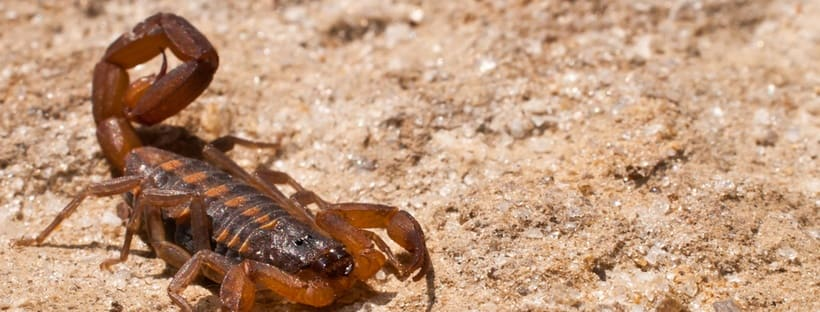
The Complete Guide to Getting Rid of Scorpions
There are approximately 1,300 species of scorpions worldwide. In the US, Scorpions are commonly found in the Southern and Southwestern United States. Most scorpions in the United States are not poisonous, except for two species found in the southwestern states of Arizona, California, New Mexico, and Texas.
Even though scorpions are common in deserts, they inhabit many other habitats as well. These different habitats include grasslands and savannahs, deciduous forests, pine forests, rainforests, and caves. Scorpions are nocturnal (they hunt for food at night).
Most of the scorpions that enter dwellings are not poisonous; a scorpion's sting is similar to bees or wasps. It's usually better to assume that they are poisonous if you are unsure.
Scorpion Identification
To get rid of scorpions successfully, you need to know how to identify them. Just like spiders, scorpions have eight legs. However, unlike spiders, scorpions have a large pair of pincers.
Scorpions have long slender bodies with a 5-segmented tail with a stinger on the tip. This tail may arch over its back.
Size varies between the various scorpion species (smallest at 1/2" long to the largest over 8 " long), but most measure about 2 inches when fully grown. Their colors range from yellow, blue, reddish-brown, and black.
Is a Scorpion an Insect?
Scorpions are arachnids, not insects, as you would think. They are close relatives to spiders, mites, and ticks.
Scorpion Inspection
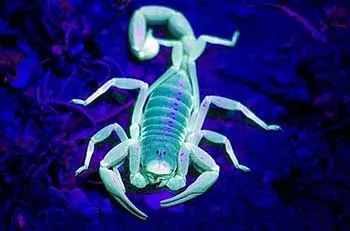
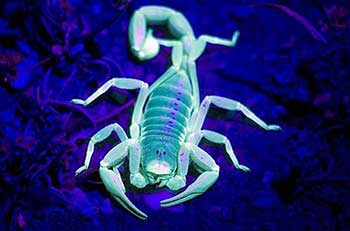
Inspection for the scorpions is made easy with the UV Tracker Light. This tracking tool has 14 Ultra Violet LEDs for a powerful flashlight that will illuminate scorpions and fluoresce rodent and cat urine, making detection and getting rid of scorpions much easier.
We recommend that you wear thick gloves, shoes, long sleeves, and long pants when you attempt to inspect for or eliminate scorpions.
Inspect the following areas outside for Scorpions
-
Under mulch, pine straw, and wood chips
-
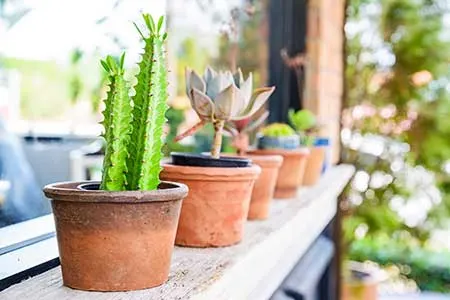
Under flower pots, stones, rocks, and retaining walls
-
In coiled hoses
-
Cracks and crevices in the structure's foundation
-
Another technique to determine if scorpions are around a building is to soak the area near the foundation with plenty of water, then cover it with plywood with a rock placed on top. This technique will provide shelter for the scorpions.
-
Check under the plywood in a couple of days for evidence of scorpions taking refuge. If there is a population, inspect the inside and outside of the building.

Check the following locations inside for Scorpions
-
In attics (Striped Back Scorpions are common in attics) and garages
-
In closets (check pockets)
-
Inside shoes and piles of clothing
-
On curtains and inside curtain rods
-
Beneath furniture
Types of Scorpions
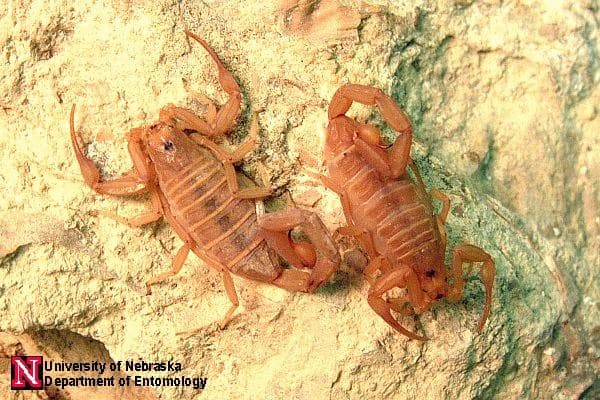
1. Striped Bark Scorpions
A typical non-poisonous scorpion is the common striped Centruroides vittatus, striped bark scorpion.
This species is widely distributed in the South Central and South Western United States(Arizona, Arkansas, Colorado, Louisiana, Montana, Nevada, New Mexico, Oklahoma, Texas, Utah, and Wyoming).
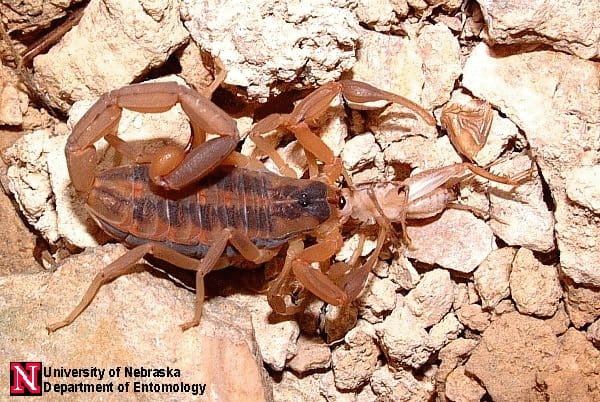
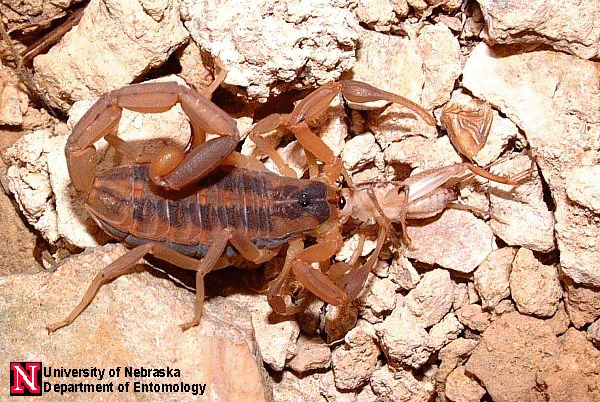
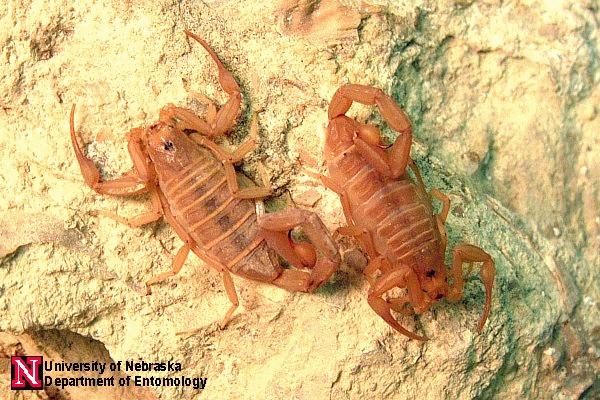
It has two broad, dark bands extending the back's length on an otherwise yellowish-brown body. This picture shows the Striped Bark Scorpion feeding on a cricket.
Size: Up to 2 3/4 inch
Reproduction and Birth: They mate in the fall, spring, and early summer months. An adult can produce several broods. Gestation is about eight months, with an average brood size of 30. After birth, the young climb on the mother's back. Afterward, the young go through their first molt and disperse to an independent life. They average molting six times before maturity.
Identifying Marks: It has two broad, dark bands extending the back's length on an otherwise yellowish-brown body. The picture above shows the Striped Bark Scorpion feeding on a cricket.
Color: They blend into their environment, and range from yellowish to tan in adults. Younger Striped back scorpions may overall be a lighter color.
Habitations: The striped bark scorpion can be found indoors or outdoors in an array of habitats. Found under vegetation, rural structures such as old sheds, surface debris, and rocks. They are nocturnal in habits, becoming active at night.
Food Habits: They consume small insects. These include pests such as beetles, flies, crickets, centipedes, spiders, and other small insects. They help reduce the local insect population. They stalk their prey at night, depending on a chemical receptor on their undersides to help with tracking their prey.
Striped Bark Scorpion Sting
Scorpion stings may cause swelling, but the sting is not typically deadly.
2. The Bark Scorpion
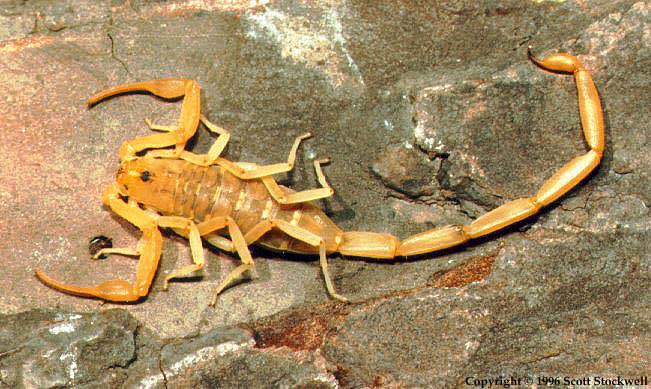
The US species, Centruroides exilicauda (Arizona Bark Scorpion-pale yellow in color), is found over much of the Southwest. Also known as the bark scorpion, they are pale and small, making them extremely difficult to see.
This scorpion venom may produce severe pain and swelling at the sting site, numbness, frothing at the mouth, difficulties in breathing (including respiratory paralysis), muscle twitching, and convulsions.
If stung, this scorpion is venomous. Call your local poison control center and go to the nearest hospital or personal physician for treatment.
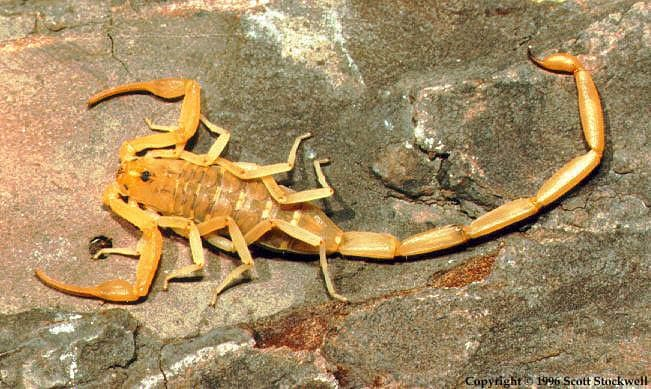
Size: Mature Adults range from 2.7-3.1 inches
Reproduction and Birth: Gestation is several months. They are born live and travel on their mother's back until their first molt. One female can produce 25-35 young.
Identifying Marks: They have two eyes on top of their heads. They have a habit of coiling the tail to one side when at rest.
Color: Ranges from yellowish-brown to tan. After Bark Scorpions molt, their color turns orange.
Habitations: In Arizona, this scorpion is found homes in and on tree bark. They can climb trees and hang from high walls and ceilings. This scorpion is unique in that it is the only common climbing scorpion. Since their eyesight is poor, they travel along walls and baseboards. They take shelter under rocks, nooks, crannies, and around and inside homes during the day.
Food Habits: They hunt for their food (roaches, crickets, and other insects)
Bark Scorpion Stings
They have a long and slender tail that holds their stinger. Certain Scorpion species in the desert Southwest can be poisonous. Scorpion stings usually occur when you accidentally step on it or brush up against it.
How to Get Rid of Scorpions
Residual Insecticides and Residual Dusts are the best methods of scorpion control. Follow the steps below to implement a successful pest control plan and get rid of scorpions from your home or yard.
-
After removing any outdoor scorpion hiding areas, like rocks, piles of rocks that are not necessary, use an encapsulated insecticide like LambdaStar Ultracap 9.7 or a wettable powder formulation like Cyper WSP to kill scorpions.
-
When spraying for scorpions, spray a band around the structure (about 3-10 feet) and spray into potential harborage areas to get rid of scorpions.
-
You may also use a dust like D-Fense or Drione Dust in attic areas, if need to get rid of scorpions in your attic.
-
You can use the UV tracker light to light up the presence of scorpions. It is best to use amber glasses when using the UV tracker light.
Best Pesticides for Scorpion Control
A. Use Residual Insecticides
During the spring and summer months, use residual insecticides in both a liquid form and dust form to get rid of scorpions.
We recommend either an encapsulated insecticide such as Czymic CS or a wettable powder formulation that mixes with water like Cyper WSP or Demon WP. If applying an insecticide dust, D-Fense Dust is one of the top scorpion control products.
Insecticides should be applied as a 3 to 10-foot band around the structure's perimeter, into harborage sites, and around potential entry points, such as: around all windows and doors, along baseboards, plumbing, inside closets, and garage and basement areas.
Residual Insecticides to Get Rid of Scorpions:
-
Both Demon WP and Cyper WSP are wettable powders that may leave a visible residue that can be seen against dark surfaces.
-
Avesta CS has a broad label (eliminates many insects) and has a long residue. It may be used inside or outside, will dry invisible, and is odorless.
-
Cyzmic CS will last longer outside and adhere to the surface better due to its encapsulated technology. Cyzmic CS 8 oz It will yield 16 gallons.
These insecticides are odorless, and the application includes both inside and outside.
B. Apply Insecticide Dusts for Scorpion Control
Insecticide dust should be used in the attic area if that is a source of entry. You may apply an insecticide Dust such as D-Fense Dust or Drione Dust with a duster. This dust would be useful in cracks and crevices, wall voids, electrical fittings, around doors and window frames, etc.
A convenient duster for dusting the attic area is a garden duster like the Dustin Mizer. It holds one pound of dust that you can crank out easily and quickly.
C. Use Glue Boards to Get Rid Of Scorpions (Non-Toxic)
As an additional measure of Scorpion control and a non-toxic method of scorpion control, place insect glue boards along the wall edges and under furniture.
Key Takeaway
Thorough interior and exterior treatments are often needed to get rid of scorpions. This may include the use of insecticide concentrates, granular insecticides, and insecticide dusts.
Prevent and Exclude Scorpions
Scorpions may invade structures and crawl under any object that provides protection. Since gaps around doors are a major entryway for these occasional invaders, seal up gaps indoors with weather stripping. Bark Scorpions have been known to climb into the tiniest of cracks.
Plug up gaps around wires and pipes. Remove any clutter inside and clean up to eliminate any possible hiding places for scorpions. Since scorpions become active in the early spring, use exclusion methods during the fall and winter months.
Stripped Bark and Bark Scorpions can not climb on clean glass. Place wide-mouth jars under tables and crib legs. If this poses a problem of potential broken glass, apply petroleum jelly on the legs.
-
Remove outdoor harborages, e.g., piles of trash, stones, boards, firewood on the ground, and landscape timbers.
-
Prune shrubs to expose the trunk and ground around the plant.
-
Remove leaf litter, mulch, and other organic debris.
-
Points of entry into buildings, e.g., siding, windows, doors, pipes, and wires, should be sealed.
-
Employ tight-fitting screens
-
Use weather stripping around doors, windows, and vents.
-
Repair leaky air conditioners
-
Scorpions in shoes
-
Be careful in picking up objects during the summer months.
-
Inspect the underside and scrutinize the object.
-
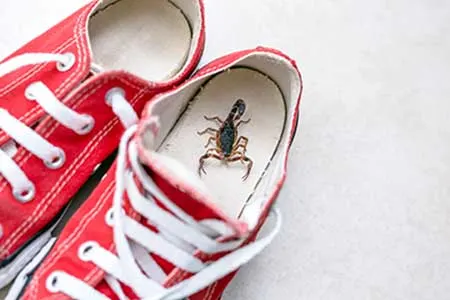
Shake out shoes and clothing vigorously before wearing them. Do not walk barefoot at night.
-
Use a UV light (which causes them to glow ) when moving about at night in scorpion-infested areas.
-
Do not swat at scorpions found on your body; brush them off instead.
If you find your scorpion infestation to be serious enough to the point where you are not confident you can handle the pest control on your own, it may be worth contacting local professional pest control companies. In most scorpions, though, using the methods and treatments we have described here is more than enough to execute an effective pest control plan for your home.
Photos: Courtesy of Jim Kalish, UNL Entomology.
Scorpion Control and How to Get Rid of Scorpions
How to get rid of scorpions & the best pesticide for scorpions

Scorpions are arachnids, not insects, as you would think. They are close relatives to spiders, mites, and ticks. There are approximately 1,300 species of scorpions worldwide. They have elongated bodies and a segmented tail that has a stinger on its tip. Scorpions are very common in the Southern and Southwestern United States.
Most scorpions in the United States are not poisonous, except for two species found in the southwestern states of Arizona, California, New Mexico, and Texas.
Even though scorpions are common in deserts, they inhabit many other habitats as well. These different habitats include grasslands and savannahs, deciduous forests, pine forests, rain forests, and caves. Scorpions are nocturnal (they hunt for food at night).
Most of the scorpions that enter dwellings are not poisonous; their sting is similar to bees or wasps. It's usually better to assume that they are poisonous if you are unsure.

Prevent and Exclude Scorpions
Scorpions may invade structures and crawl under any object that provides protection. Since gaps around doors are a major entryway for these occasional invaders, seal up gaps indoors with weather stripping. Bark Scorpions have been known to climb into the tiniest of cracks. Plug up gaps around wires and pipes. Remove any clutter inside and clean up to eliminate any possible hiding places for scorpions. Since scorpions become active in the early spring, use exclusion methods during the fall and winter months.
Scorpions can not climb on clean glass. Place wide- mouth jars under tables and crib legs. If this poses a problem of potential broken glass, apply petroleum jelly on the legs.
- Remove outdoor harborages, e.g., piles of trash, stones, boards, firewood on the ground, and the landscape timbers.
- Prune shrubs to expose trunk and ground around the plant.
- Remove leaf litter, mulch, and other organic debris.
- Points of entry into buildings, e.g., siding, windows, doors, pipes, and wires, should be sealed.
- Employ tight-fitting screens
- Use weather stripping around doors, windows, and vents.
- Repair leaky air conditioners
A. Using Residual Insecticides
During the spring and summer months, use residual insecticides in both a liquid form and dust form. We recommend either an encapsulated insecticide such as Avesta CS or a wettable powder formulation like Demon WP that mixes with water like.
Dust in void areas with an insecticide dust. We recommend D-Fense Dust. It is also helpful to use DIY Pest Control Trapper Insect Traps inside along the baseboards.
Insecticides should be applied as a 3 to 10-foot band around the structure's perimeter, into harborage sites, and around potential entry points, such as: around all windows and doors, along baseboards, plumbing, inside closets, and garage and basement areas.
Both Demon WP is a wettable powders that may leave a visible residue that can be seen against dark surfaces. Avesta CS has a broad label (eliminates many insects) and has a long residue. It may be used inside or outside, will dry invisible, and is odorless. Avesta CS will last longer outside and adhere to the surface better due to its encapsulated technology. Avesta CS 8 oz It will yield 16 gallons.
These insecticides are odorless, and the application includes both inside and outside.
B. Using Insecticide Dusts
Insecticide dust should be used in the attic area if that is a source of entry. You may apply an insecticide Dust such as D-Fense Dust or Drione Dust with a duster. This dust would be useful in cracks and crevices, wall voids, electrical fittings, around doors and window frames, etc.
A convenient duster for dusting the attic area is a garden duster like the Dustin Mizer. It holds one pound of dust that you can crank out easily and quickly.
C. Using Glue Boards
As an additional measure of control and a non-toxic method of scorpion control, place insect glue boards along the wall edges and under furniture.
- Be careful in picking up objects during the summer months.
- Inspect the underside and scrutinize the object.
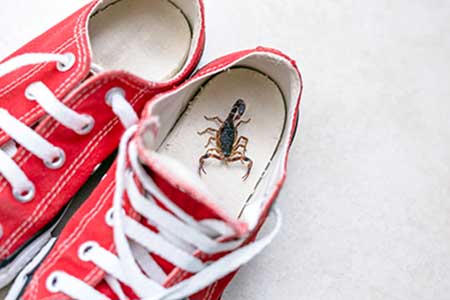
- Shake out shoes and clothing vigorously before wearing them. Do not walk barefooted at night.
- Use a UV light ( causes them to glow ) when moving about at night in scorpion infested areas.
- Do not swat at scorpions found on your body; brush them off instead.
Best Pestcides for Scorpion Control
Scorpion Inspection
Inspection for the scorpions is made easy with the UV Tracker Light. This tracking tool has 14 Ultra Violet LEDs for a powerful flashlight that will illuminate scorpions and fluoresce rodent and cat urine, making detection easier.
We recommend that you wear thick gloves, shoes, long sleeves, and long pants if you come across a scorpion.
Inspect the following areas outside
- Under mulch, pine straw, and wood chips
- Under flower pots, stones, rocks and retaining walls
- In coiled hoses
- Cracks and crevices in the structure's foundation
- Another technique to determine if scorpions are around a building to soak the area near the foundation with plenty of water, then cover it with plywood with a rock placed on top. This technique will provide shelter for the scorpions. Check under the plywood in a couple of days for evidence of scorpions taking refuge. If there is a population, inspect inside and outside the building.
Check the following locations inside
- In attics (Striped Back Scorpions are common in attics) and garages
- In closets (check pockets)
- Inside shoes and piles of clothing
- On curtains and inside curtain rods
- Beneath furniture

Key Takeaway
Thorough interior and exterior treatments are often needed for suitable control of scorpions. This may include the use of insecticide concentrates, granular insecticides and insecticide dusts.
Scorpion Identification and Inspection
Scorpion Identification
Just like spiders, scorpions have eight legs. However, unlike spiders, scorpions have a large pair of pincers. Scorpions have a long slender body with a 5-segmented tail that may arch over the back. Size varies between the various scorpion species (smallest at 1/2" long to the largest over 8 " long), but most measure about 2 inches when fully grown. Their colors range between yellow, blue, reddish-brown, and black.
Scorpion illuminated with UV Tracker Light
Stripped Bark Scorpions
A typical non-poisonous scorpion is the common striped Centruroides vittatus, striped bark scorpion. This species is widely distributed in the South Central and South Western United States(Arizona, Arkansas, Colorado, Louisiana, Montana, Nevada, New Mexico, Oklahoma, Texas, Utah, and Wyoming). It has two broad, dark bands extending the back's length on an otherwise yellowish-brown body. This picture shows the Striped Bark Scorpion feeding on a cricket.
Size: Up to 2 3/4 inch
Reproduction and Birth: They mate in the fall, spring, and early summer months. An adult can produce several broods. Gestation is about eight months, with an average brood size of 30. After birth, the young climb on the mother's back. Afterward, the young go through their first molt and disperse to an independent life. They average molting six times before maturity.
Identifying Marks: It has two broad, dark bands extending the back's length on an otherwise yellowish-brown body. The picture above shows the Striped Bark Scorpion feeding on a cricket.
Color: They blend into their environment, range from yellowish to tan in adults. Younger Striped back scorpions may overall be a lighter color.
Habitations: The striped bark scorpion can be found indoors or outdoors in an array of habitats. Found under vegetation, rural structures such as old sheds, surface debris, and rocks. They are nocturnal in habits, becoming active at night.
Food Habits: They consume small insects such as beetles, flies, crickets, centipedes, spiders, and other small insects. They help reduce the local insect population. They stalk their prey at night, depending on a chemical receptor on their undersides to help with tracking their prey.
Stings: Their stings may cause swelling, but the sting is not typically deadly.
Bark Scorpions
The US species, Centruroides exilicauda (Bark Scorpion-pale yellow in color), is found over much of the Southwest. Also known as the bark scorpion, they are pale and small, making them extremely difficult to see. The venom of this scorpion may produce severe pain and swelling at the sting site, numbness, frothing at the mouth, difficulties in breathing (including respiratory paralysis), muscle twitching, and convulsions. If stung, the Bark Scorpion is venomous, call your local poison control center and go to the nearest hospital or personal physician for treatment.
Size: Mature Adults range from 2.7-3.1 inches
Reproduction and Birth: Gestation is several months. They are born live and travel on their mother's back until their first molt. One female can produce 25-35 young.
Identifying Marks: They have two eyes on top of their heads. They have a habit of coiling the tail to one side when at rest.
Color: Ranges from yellowish-brown to tan. After Bark Scorpions molt, their color turns orange.
Habitations: In Arizona, this spider is found homes in and around some bark. They can climb trees and hang from high walls and ceilings. Since their eyesight is poor, they travel along walls and baseboards. They take shelter under rocks, nooks, crannies, and around and inside homes during the day.
Food Habits: They hunt for their food (roaches, crickets, and other insects)
Stings: They have a long and slender tail that holds their stinger. Certain species in the desert Southwest can be poisonous. Stings usually occur when you accidentally step on it or brush up against it.
Photos: Courtesy of Jim Kalish, UNL Entomology.
Written by our resident pest control expert Ken Martin.