



How to Get Rid of Wasps
Wasp Nest Removal: How To Get Rid of Wasp and Hornet Nests
December 16th, 2023
How to Get Rid of Wasp and Hornets
Pest control can be intimidating when dealing with wasps and hornets. In many cases, you can DIY pest control your home and property for wasps without needing to call a pest control company or pest control expert.
Recommended Wasp Control Products
Aerosols - Get A Quick Knockdown On A Wasp Nest
PT Wasp & Hornet Freeze, Wasp-X, Bonide Wasp & Hornet Aerosol are aerosols that would give a rapid knockdown of the wasp nest. It kills wasps instantly.
You can spray the wasp nests from as far away as 15-20 feet. These quick-kill wasp aerosols have oily bases, so care should be considered when using them not to stain a surface.
EcoPco Jet Contact Insecticide Aerosol is another alternative to get rid of wasps. The ECO PCO line is much less toxic than other insecticides because they are made up of botanical lines.
It's crucial that you wear protective clothing while spraying for wasps. Without protective clothing like long pants and a jacket, you run the risk of being stung multiple times.
In general, we don't recommend using a homemade wasp trap, as many are not effective at getting rid of the wasps long-term.
Wasp Control Products that We Recommend:
-
Stryker Wasp and Hornet or Styker 54 Aerosols
-
Stryker Wasp & Hornet Killer
-
PT Wasp Removal & Hornet Freeze
-
Zenprox Wasp-X2
-
Bonide Wasp & Hornet Aerosol
-
When To Spray Wasp Nests
Recommended Insecticide Dust and Traps
-
Tempo Dust for Wasp Removal
-
PFT Yellow Hanging Stations
How to Get Rid of Wasps Inside
A common misconception about these insects is that they are only found outdoors. In reality, there's plenty of room inside your home - even if you live in an apartment or condo. So if they come inside, how do you get rid of wasps?
Our tips to prevent wasps from coming inside:
-
Find their entry points, even small tiny gaps.
-
Ensure all cracks and access points have been sealed up tightly with silicone caulk.
-
Inspect your eaves and the mortar between the bricks
-
Inspect Home vents
Wasp and Hornet Identification
Before you can discover how to get rid of wasps most effectively, it helps to identify the species you are dealing with. Discovering a wasp infestation can be alarming, but with the correct identification and tools, you can kill the entire nest and all the wasps inside.
There are over 100,000 species of wasps worldwide. The most common species is the paper wasp. Hornets and yellowjackets are also classified as vespid wasps, but some people mistake them for bees.
Wasps can nest in many areas and prefer places like attics, sheds, chimneys, and eaves. One of the biggest threats from wasps is their ability to defend their colony. They will attack and sting when disturbed, or their nests are threatened.
Wasp Stings
Unlike bees, they can sting several times without causing harm to themselves. Their stings can lead to serious complications if attacked by a swarm or if you have an allergic reaction to their venom.
They are most aggressive around nest sites and present the greatest danger when they nest near an entrance to a home or office. Continue reading for tips on wasp control around the home and office.
Wasp Behavior
Wasps release pheromones that signal other wasps in the colony to attack when they feel threatened. They can call the entire swarm for help. Hundreds of people die each year from allergic reactions to wasp venom.
Hornets are also a problem in beekeeping communities because they can feed on bees and eliminate a whole colony in hours.
Difference between a Wasp and a Bee
The main difference between a wasp and a bee is that wasps feed on other insects, while mostly paralyzed arthropods and bees feed on a mixture of pollen and nectar. Wasps live off other insects, primarily spiders.
Wasps have smooth bodies as opposed to bees which have hairy bodies. They are about 1/2 inch to 3/4 inch long with a variety of colors and shapes.
Stinging Wasps
There are two types of wasps, social wasps, and solitary wasps. Social wasps, such as Yellow Jackets, Hornets, and Paper Wasps, usually have a larger population than solitary wasps, like Mud Daubers and Cicada Killers.
The stinging wasps belong to the family, Vespidae. Solitary wasps also sting but are used primarily for subduing prey (solitary wasps rarely sting humans).
When you spot wasp activity, one way to identify a stinging wasp is to note its wings when they are at rest. They fold their wings lengthwise, making them seem half as wide as they are. Most wasps build their nest from wood fibers, producing a paper shelter.
These wasps are inactive during the winter months and hide in protective coverings. The queen makes the nests and feeds the young larvae.
Best Way To Prevent Wasp Nests
The best way to prevent a wasp nest is to use a broad-spectrum insecticide like Avesta CS in areas where you anticipate wasps will build nests.
Avesta CS is labeled for a wide variety of bugs, so you can use them again for your next insect problem. Avoid spraying the wasp nest directly during the day so you do not get stung.
Spray the wasp or hornet nest liberally. If you're using a freezing agent in a wasp aerosol spray form, spray when most wasps are home at night to eliminate the infestation.
All recommended products continue to work for a long period after application, so a second treatment generally isn't needed. If the wasp nest is in a high-traffic area, check it again to ensure all wasps are dead. Once you have verified that the wasps have been killed, remove the wasp nest.
What Wasps Are Looking For In Your Yard
Shelter: Wasps need shelter and food sources to survive. There are a few common places to look for wasp activity. They hide in protected areas such as attics, walls, under tree bark, stonewalls, or other sheltered locations. The queens are inactive during the winter months. They emerge during the spring and begin to build wasp nests.
Food: The Wasp queen seeks food for her larvae, and the emerging workers and male wasps start searching for food. They start with protein-based food like other insects, but as the season progresses into the fall, they search for sugar items.
Types of Wasps - Social Wasps and Solitary Wasps<
Social Wasps
-
Yellow Jackets
-
Hornets
-
Paper Wasps
Most social wasps live in nests and defend them aggressively.
The Bald-faced hornet (Dolicho-Vespula maculata (sometimes called white-faced hornet)), European or giant hornet (Vespa crabro), and Yellow Jackets (Vespula spp.) are prominent structure-infesting wasps.
The Yellowjackets are the smallest of the common vespids. These wasps of the Vespid family are beneficial social wasps that live in colonies with thousands of individuals.
What Attracts Wasps?
These hornets are threatening because of their opportunistic behavior of nesting in structural voids, attics, and any cavities in landscaping features. They scavenge in trash containers and look for food and drinks that are consumed outdoors. Particularly, sweet foods attract wasps. They will eat ripe fruit in gardens and vineyards, as well as any fruit juice or fallen fruit near garbage cans.
As the temperature cools in the fall months with reduced food supplies, they may seek shelter in warm shelters, invading human structures. Their colonies peak in the late summer and fall and are most noticeable around the home.
-
Typical "wasp" body type: - a short, narrow attachment between the thorax and the abdomen, which is spindle-shaped and tipped with a long stinger.
-
Thorax and abdomen are brightly marked with yellow, red, or brown on a black background. Many hornets are confused with yellow jackets.
1. Yellow Jackets
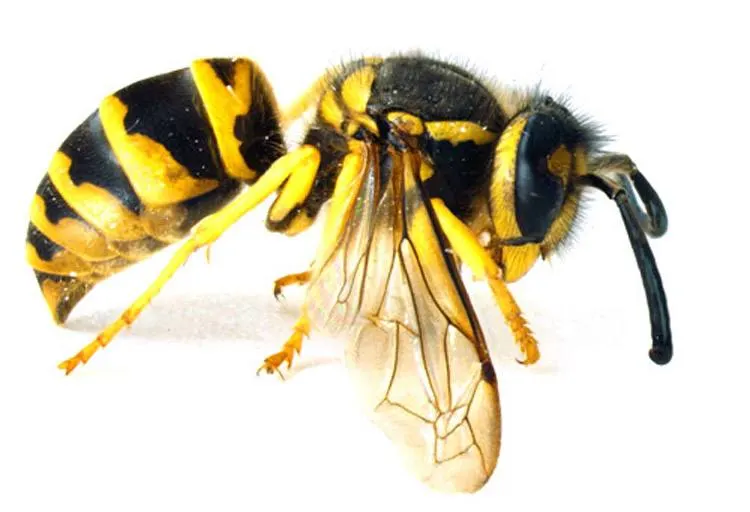
Yellow jackets have bright yellow and black patterns. As social wasps, they will aggressively defend their nests. Yellow Jackets have thin waists, while bees have thicker waists. They typically build their nests in the ground. Many times their nests start from an abandoned animal burrow. They feed on meats and sweets.
Nests: Yellow Jackets may form a nest in the ground or structures.
Yellow Jacket Control
-
Yellow Jacket Wasp Removal - The best way is to locate and get rid of the wasp nests at night.
-
If you can not treat the wasp nest, there are yellow jacket bait stations that are effective.
-
Learn more about Yellow Jacket Wasp Control.
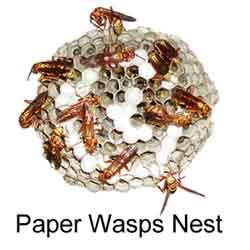
These wasps are also called umbrella wasps due to their nests' shape.
Paper Wasps have a coloration of yellow, brown, or red patterns on black. The Paper Wasp of the family Poliste commonly builds its nest under the eaves of houses or porch roofs.
Paper wasps, hornets, and yellow jackets construct nests of a paper-like material, a mixture of finely chewed wood fragments and salivary secretions of the wasps. Paper wasps typically build their umbrella-shaped nests under eaves and ledges.
Paper Wasps Control
-
While these wasps are not as aggressive as yellow jackets or hornets, disturbing paper wasp nests can still be dangerous. They can be eliminated rather easily with a wasp and hornet sprays such as Bonide Wasp and Hornet Killer or PT Wasp and Hornet Killer.
-
After that, dust insecticidal dust like Tempo Dust into their entrance at night. Wear protective clothing and try not to use any lights. Even with a Paper Wasp nest, you still can get stung. Treatment can be accomplished by applying a wasp and Hornet aerosols.
3. Hornets
Bald-Faced Hornet
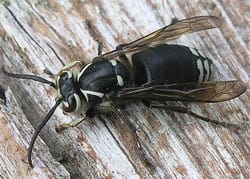
The bald-faced hornet (Dolichovespula maculata) is a large, black and white-colored, social wasp that is found throughout North America. It is not a true “hornet" but is more closely related to the yellowjacket.
The bald-faced hornet ranges in length from three-quarters of an inch to just over an inch. They have a black, relatively hairless body with white to pale yellow patches on their face and thorax and three distinctive white stripes around the end of their abdomen.
Giant European Insect Hornets
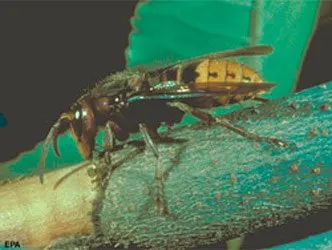
Giant European Insect Hornets have yellow and brown coloring. They will aggressively defend their nests. A fertilized queen hibernates during the winter and emerges in the spring to establish new nests. Each colony may have 300 or more workers. They are active during the summer and spring months and are attracted to sweet foods.
They are not as aggressive as yellow jackets. Some hornets are yellow and black and are confused with Yellow Jackets.
Giant European Insect Hornet Nests
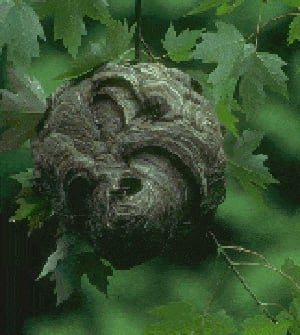
Nest: Giant European Hornet nests resemble a large, inverted tear-drop-shaped ball that typically is attached to a tree, bush, or side of a building. Hornet nests may contain thousands of wasps, which are extremely aggressive when disturbed.
Hornets are most commonly found in hollow trees. However, hornets' nests also can be found in barns, attics, hollow walls, and abandoned beehives. The hornets' nests built in unprotected places are covered with a brown envelope (paper) composed of chewed plant fibers. They gather bark from trees and leave small rings around the trunks of the trees. Many Hornets have large grayish-brown cartons like structures; they are often hanging from a tree or bush.
Solitary Wasps (Non-Social)
Species such as the Sphecid wasps, Cicada Killers, Mud Daubers, Potter Wasps, Spider Hunter Wasps, and Cricket Hunter wasps
The solitary wasps are Sphecid wasps, Cicada Killers, Mud Daubers, Potter Wasps, Spider Hunter Wasps, and Cricket Hunter wasps. Solitary wasp species have one female that builds either one nest or several distinct nests.
Cartons are not used in these nests. Each nest has several cells. Prey (another insect or spider) is placed in a cell with an egg laid on top; then, it is sealed. They do not fold their wings when they fly like social wasps. Some solitary wasps build their nests in the ground, like digger wasps and cicada killers.
-
Cicada Killer Wasps
-
Mud Daubers
1. Cicada Killer Wasps
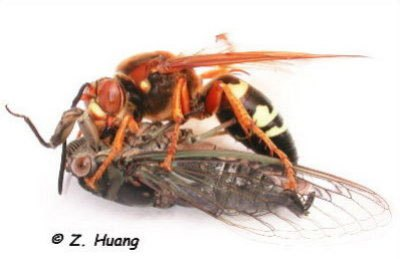
The Cicada Killer, a solitary wasp, is often mistaken for a hornet. Cicada killers are very common in the USA.
The female Cicada Killer will drag the paralyzed cicadas. The larvae will consume the live Cicada in the following days. A burrow may have up to 20 cells with 1-2 cicadas and one egg per cell. The egg hatches into larvae to feed on the Cicada. The larvae spin a cocoon afterward and enter a dormancy thru the winter(overwinter) and pupate the following spring, continuing the cycle.
Cicada Killer Wasp Control and Prevention
-
If you notice fresh holes or a developing wasp nest, you can try applying Tempo Dust to the holes' entrance. When the holes are new, you still have the potential to kill the larvae and adults.
-
A more permanent and preventative method to get rid of these wasps would be to apply Bifen LP Granules over the whole area and water it in. The Bifen LP Granules would not yield immediate results but stop them from returning the following year.
2. Mud Daubers
Mud Daubers and sphecid wasps are solitary wasps. Many people mistake the Cicada Killer for hornets. True hornets do not excavate burrows in the ground, such as the Cicada Killer.
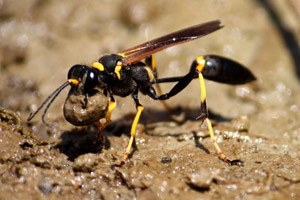
Here is an excellent video from the University of California describing the difference between yellow jackets, wasps, and mud daubers.
DIY Pest Control for Wasps
Instead of calling a professional exterminator right away, you can give our friendly team of pest control experts a call. We'll recommend pesticide spray and insecticides for wasps and other pests.
How To Get Rid of Wasps and Hornets
Wasp Nest Removal: How To Get Rid of Wasp and Hornet Nests

-
Types of Wasps This is a list of some wasps that you may encounter in your yard or around your home. The behavior of wasps may vary, so it's important to identify what kind you have before getting started with handling.
The best way of getting rid of wasps and hornet nests
We Recommend
- Remove the nest at night.
- After you locate the nest, cover it with a garbage bag; gently pull the nest from the wall or tree (where it is attached) and seal the bag. You can leave the bag in the sunlight or freeze the bag to kill the wasps. Dusting the area with Tempo Dust will kill any stragglers that were not removed from the nest.
- See Yellow Jacket Prevention for tips to prevent yellow jackets and hornets.
- When To Spray A Wasp Nest
Key Takeaway
Regardless of the insecticide being used, treating wasps and hornets after dark will greatly reduce your chances of being stung.
Best Way To Prevent Wasps Nests
The best way to prevent a wasp nest, is to use a broad-spectrum insecticide like Avesta CS in areas where you anticipate wasps will build. Avesta CS is labeled for a wide variety of bugs so you can use them again for your next insect problem. Avoid spraying the nest directly during the day so you do not get stung.
Spray the nest liberally. If you're using a freezing agent in a wasp aerosol spray form, spray when most wasps are home at night to eliminate the infestation. All recommended products continue to work for a long period after application, so a second treatment generally isn't needed. If the nest is in a high traffic area, check it again to ensure all wasps are dead. Once you have verified that the wasps have been eliminated, remove the nest.
Getting Rid of Wasp and Hornets
Recommended Wasp Control Products
Aerosols - Get A Quick Knockdown
PT Wasp & Hornet Freeze, Wasp-X, Bonide Wasp & Hornet Aerosol are aerosols that would give a rapid knockdown of the wasp nest. You can spray as far away as 15-20 feet. These quick kill wasp aerosols have oily bases, so care should be considered when using not to stain a surface. EcoPco Jet Contact Insecticide Aerosol is another alternative. The ECO PCO line is much less toxic than other insecticides because they are made up of botanical lines.
We Recommend
Tips to Get Rid of Wasps Inside
We Recommend
- Check every entry point, even small tiny gaps.
- Inspect your eaves and the mortar between the bricks
- Inspect Home vents
- Ensure all cracks and access points have been sealed up tightly with silicone caulk.
What Wasps Are Looking For In Your Yard
Shelter: Wasps need shelter and food sources to survive. They hide in protected areas such as attics, walls, under tree bark, stonewalls, or other sheltered locations. The queens are inactive during the winter months. They emerge during the spring and begin to build nests.
Food: She seeks food for her larvae, and the emerging workers and male wasps start searching for food. They start with protein-based food like other insects, but as the season progresses into the fall, they search out sugar items.
Wasp and Hornet Identification
Stinging Wasps
There are two types of wasps, social wasps, and solitary wasps. The social wasps such as Yellow Jackets, Hornets, and Paper Wasps usually have a larger population than solitary wasps, like Mud Daubers and Cicada Killers.
The stinging wasps belong to the family, Vespidae. Solitary wasps also sting but are used primarily for subduing prey (the solitary wasps rarely sting humans).
One way to identify a stinging wasp is to note their wings when they are at rest. They fold their wings lengthwise, making them seem half as wide as they are. Most wasps build their nest from wood fibers, producing a paper shelter. These wasps are inactive during the winter months and hide in protective coverings. The queen makes the nests and feeds the young larvae.
Difference between a Wasp and a Bee
The main difference between and wasp and bee is that wasps feed on other insects, while mostly paralyzed arthropods and bees feed on a mixture of pollen and nectar. Wasps have smooth bodies as opposed to bees that have hairy bodies. They are about 1/2 inch to 3/4 inch long in a variety of colors and shapes. They live off other insects, primarily spiders.
Wasp Control Products
Types of Wasps - Social Wasps and Solitary Wasps
Social Wasp-Yellow Jackets, Hornets, and Paper Wasps
Most social wasps live in nests and defend it aggressively and are vespid wasps (family Vespidae)
The Bald-faced hornet (Dolicho-Vespula maculata (sometimes called white-faced hornet), European or giant hornet (Vespra crabro), and Yellow Jackets (Vespula spp.) are prominent structure-infesting wasps. The Yellowjackets are the smallest of the common vespids. These wasps of the Vespid family are beneficial social wasps that live in colonies with thousands of individuals. These hornets are threatening because of their opportunistic behavior of nesting in structural voids, attics, and any cavities in landscaping features. They scavenge in trash containers and look for food and drinks that are consumed outdoors. They will eat ripe fruit in gardens and vineyards. As the temperature cools in the fall months with reduced food supplies, they may seek shelter in warm shelters, invading human structures. Since their colonies peak in the late summer and fall, their colonies are most noticeable. Paper Wasps are social wasps; they are also called umbrella wasps due to their nests' shape.
- Typical "wasp" body type: - a short, narrow attachment between the thorax and the abdomen, which is spindle-shaped and tipped with a long stinger.
- Thorax and abdomen brightly marked with yellow, red, or brown on a black background. Many hornets are confused with yellow jackets.
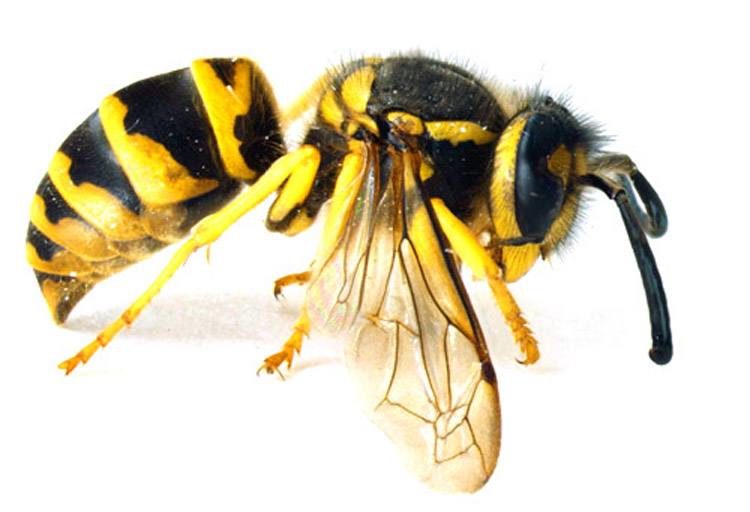
Yellow Jackets
Yellowjackets have bright yellow and black patterns. As a social wasp, they will aggressively defend their nests. Yellow Jackets have thin waists, while bees have a thicker waist. They typically build their nests in the ground. Many times their nests start from an abandoned animal burrow. They feed on meats and sweets.
Nests: Yellow Jackets may form a nest in the ground or structures.
- Control: The best way is to locate and treat the nests at night. If you can not treat the nest, there are yellow jacket bait stations that are effective.
- Learn more about their control at Yellow Jacket Control.
Paper Wasps
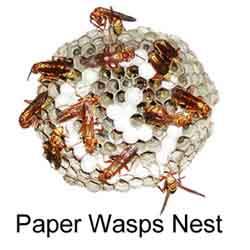
Paper Wasps-Polistes spp, Family Vespidae: These wasps are also called umbrella wasps due to their nests' shape.
Paper Wasps have a coloration of yellow, brown, or red patterns on black. The Paper Wasp of the family Poliste commonly builds its nest under the eaves of houses or porch roofs. Paper Wasps are social wasps. Paper wasps, hornets, and yellow jackets construct nests of a paper-like material, a mixture of finely chewed wood fragments and salivary secretions of the wasps. Paper wasps typically build their umbrella-shaped nests under eaves and ledges.
- These wasps are not as aggressive as yellow jackets or hornets and can be eliminated rather easily with a wasp and hornet sprays such as Bonide Wasp and Hornet Killer or PT Wasp and Hornet Killer.
- After that, dust insecticidal dust like Tempo Dust into their entrance at night. Wear protective clothing and try not to use any lights. Even with Paper Wasp, you still can get stung. Treatment can be accomplished by applying a wasp and Hornet aerosols.
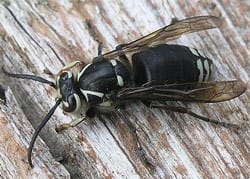
The bald-faced hornet (Dolichovespula maculata) is a large, black and white-colored, social wasp that is found throughout North America. It is not a true “hornet" but more closely related to the yellowjacket. The bald-faced hornet ranges in length from three-quarters of an inch to just over an inch. They have a black, relatively hairless body with white to pale yellow patches on their face and thorax and three distinctive white stripes around the end of their abdomen.
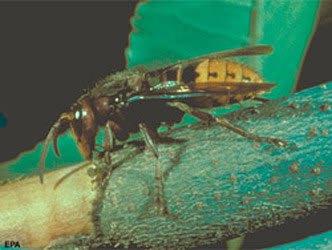
Giant European Insect Hornets have yellow and brown coloring. They will aggressively defend their nests. A fertilized queen hibernates during the winter and emerges in the spring to establish new nests. Each colony may have 300 or more workers. They are active during the summer and spring months and are attracted to sweet foods. They are not as aggressive as yellow jackets. Some hornets are yellow and black and are confused with Yellow Jackets.
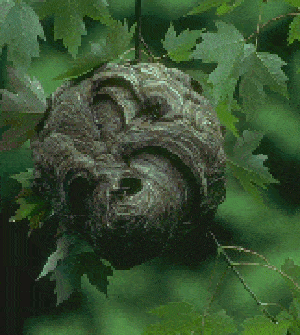
Nest: Giant European Hornet nests resemble a large, inverted tear-drop shaped ball that typically is attached to a tree, bush, or side of a building. Hornet nests may contain thousands of wasps, which are extremely aggressive when disturbed. Hornets are most commonly found in hollow trees. However, hornets' nests also can be found in barns, attics, hollow walls, and abandoned beehives. The hornets' nests built in unprotected places are covered with a brown envelope (paper) composed of chewed plant fibers. They gather bark from trees and leave small rings around the trunks of the trees. Many Hornets have large grayish-brown cartons like structure; they are often hanging from a tree or bush.
Solitary Wasps (Non-Social) - Sphecid wasps, Cicada Killers, Mud Daubers, Potter Wasps, Spider Hunter Wasps, and Cricket hunter wasp
The solitary wasps are Sphecid wasps, Cicada Killers, Mud Daubers, Potter Wasps, Spider Hunter Wasps, and Cricket hunter wasps. Solitary wasps species have one female that builds either one nest or several distinct nests.
Cartons are not used in these nests. Each nest has several cells. Prey (another insect or spider) is placed in a cell with an egg laid on top; then, it is sealed. They do not fold their wings when they fly like social wasps. Some solitary wasps build their nests in the ground, like digger wasps and cicada killers. The Cicada Killer, a solitary wasp, is mistaken for a hornet. Cicada killers are very common in the USA.
Cicada Killers
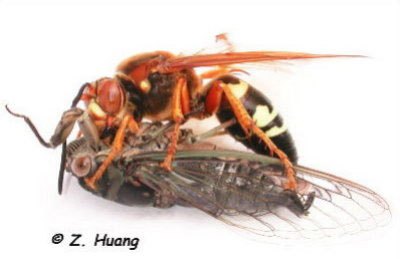
The female Cicada Killer will drag the paralyzed cicadas. The larvae will consume the live Cicada in the following days. A burrow may have up to 20 cells with 1-2 cicadas and one egg per cell. The egg hatches into larvae to feed on the Cicada. The larvae spin a cocoon afterward and enter a dormancy thru the winter(overwinter) and pupate the following spring, continuing the cycle.
Cicada Killer Control and Prevention
- If you notice fresh holes or developing a nest, you can try applying Tempo Dust to the holes' entrance. When the holes are new, you still have the potential to kill the larvae and adults.
- A more permanent and preventative method would be to apply Bifen LP Granules over the whole area and water it in. The Bifen LP Granules would not yield immediate results but stop them from returning the following year.
Mud Daubers
Mud Daubers and sphecid wasps are solitary wasps. Many people mistake the Cicada Killer for hornets. True hornets do not excavate burrows in the ground, such as the Cicada Killer.
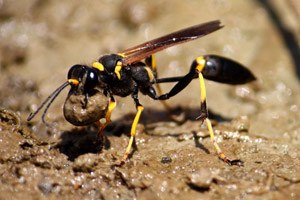
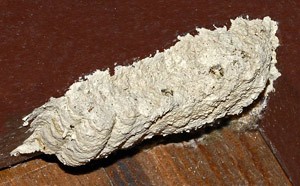
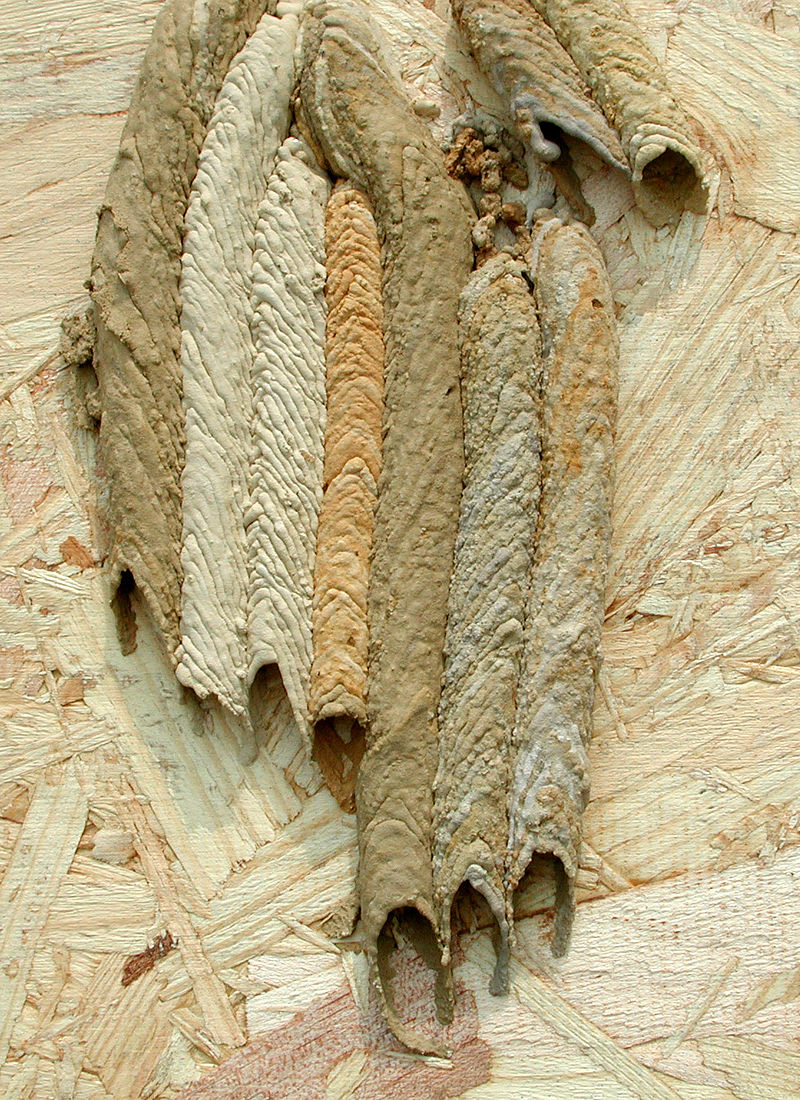
Here is an excellent video from University of California describing the difference between yellow jackets, wasps and mud daubers.
Written by our resident pest control expert Ken Martin.