


do it yourself pest control, info, ants, termites, spiders, bed bugs, rodents, supplies, products, mouse, rats, traps, baits, insecticides, roaches, moles, mole control, mole bait, ant bait, maxforce, flies,fly control products,termite baits,  termidor, carpenter ants, carpet beetles, brown recluse, black widow,fire ants,ladybugs,mosquitoes free shipping and fast delivery
Stable Fly Control

Product Search:


  Home > Flies >  Nuisance Flies >  Flesh Flies > Fly Control Products


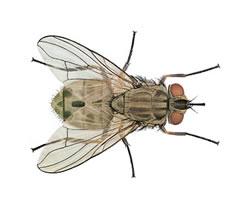
Photo Credit: Tom Myers


Stable flies are known for their bites, they are also called "biting flies". They bite people, livestock,pets and other mammals. The bites may feel like a needle stab. Most bites occur around the ankles and lower parts of the legs.
Stable flies are very persistent when searching for a blood meal.

Identification of the Stable Fly

Size: About 1/4 inch long

The identity of the Stable Fly is sometimes confused with the House Fly.

    The STABLE FLY can be easily distinguished from other common domestic flies by the long, pointed proboscis which extends in front of the head.

Both males and females use this proboscis to pierce the skin of a host and suck blood. The bite is painful and outdoor human activity may be curtailed when these flies are numerous.

The Stable fly ingests liquids by piercing (bites), while the house fly has a sponging mouth part.

Biology of Stable Flies

Eggs are laid in sch places as decaying hay, straw, fermenting weeds, grass and sea weeds.

The eggs hatch from 1 to 3 days into yellowish-white maggots or larvae. These larvae pass through 3 instars and pupate in the last larval skin. In warm weather the pupal stage lasts 6 to 20 days. The average adult lives about 20 days.


The early morning and late afternoon hours are commonly peak feeding times.

Peak activity usually occurs during warm periods following rainfall.


Stable flies like to feed on the lower parts of the hosts such as the legs and belly of horses and cattle.

Cattle, horses, and people are typically bitten on the legs; dogs and swine are generally bitten on the ears.

Even though the female requires a blood meal in order to lay eggs, both male and female feed on blood.

About 60 - 120 eggs are laid at a time with some flies surviving to lay two or more batches of eggs

. Eggs hatch in less than 24 hours to produce larvae (maggots) that feed and grow beneath the surface of the breeding material.

Breeding sites include rotting straw or straw hay, wet and decaying spilled grain, fermenting piles of vegetation (such as weed or grass cuttings), silage, and manure in mounds .


Inspecting for Stable Flies

Stable flies are commonly found around stables and houses, and also along the seashore and near dog kennels.

Stable flies prefer to feed outdoors and rarely are found feeding or resting indoors.


The false stable flies and dump flies may also be problems in certain areas. They are non-biting flies.

Control and Elimination

Recommended Control and Elimination Measures for Stable Flies

Exclusion and Sanitation, Baits, Insecticides, Traps, and Aerosols

1. Exclusion and Sanitation:

  • Ongoing sanitation is critically important in stables to eliminate the breeding material, reducing and eliminating the population. Stable flies
    breed in decaying grass or crop clippings, hay residues, and silage. Because
    they are extremely strong fliers, the source of the infestation may be located
    up to several hundred miles away.
  • Whenever possible, food and materials on which the flies can lay their eggs must be removed, destroyed, as a breeding medium, or isolated from the egg-laying adult. Killing adult flies will reduce infestation, but elimination of breeding areas is necessary for good management.

  • The key to controlling these infestations is to locate and eliminate their breeding sources.

    .

  • A space spray cb 80 CB 80 Pyrethrin Aerosol

    (Pyrethrin spray) can be used as a quick kill, reducing populations of flying insects.

  • Garbage cans and dumpsters should have tight-fitting lids and be cleaned regularly.

  • Drainage will often aid control, getting rid of extra moisture.

  • Openings of buildings should be tightly screened with screen.

2. Insecticides : Residual, Aerosols, and Fogging


House flies rest on sunny surfaces in the daytime, and have a tendency to come inside or under eaves at night. These areas where the flies are resting can be sprayed with residual or contact insecticides.
The flies rest on the sprayed surface and pick up enough insecticide to kill them.
When spraying the surfaces, it should be wet enough to the point of runoff, but not enough to form puddles.
Recommended residual Insecticides:

Demon WP  or  cyper wpCyper WP  are wettable powders, mixed with water to spray exterior surfaces where flies would land, sprayed once a month. Wettable powders will show up visible on dark surfaces

Use cyonara 9.7Cyonara 9.7 if you are concerned about the visiblity on dark surfaces.

Cyonara 9.7, Demon WP or Cyper WP would all work equally well.

Aerosols
Hand held space sprays for a quick knock down would be pyrethrin contact aerosols:
A space spray cb 80 CB 80 Pyrethrin Aerosol

(Pyrethrin spray) can be used as a quick kill, reducing populations of flying insects.  V Tech Metered Aerosol /  Automatic Dispenser   is an automatic dispenser to be used with the the V Tech Mist Metered Insect Killer.
The V Tech Mist Automatic aerosol will last 30 days.

Fogging Insecticides-Non Residual
If you find that fogging inside a building would be neccessary, we also carry fogging material and professional fogger equipment:
Fogging Compounds and Equipment

3. Trapping-Glue and Outside

Fly Paper-1 ribbon=3 ft.x1 inch strip of sticky paper .

Window Fly Trap-allows you to use a trap to stick on the window, without using an insecticide.

disposable fly trapECO Fly Trap Disposable Fly Traps is an excellent trap for the outside, with a unique attractant lure included.
It will trap house flies, blow flies and a broad range of other fly species. Place the ECO Fly Trap disposable fly traps and the fly baits away from areas that you want to see flies, in that they have attractants that will draw the flies.
You will want to place the outside ECO Fly Trap disposable trap in sunny area on cooler days and shady areas on warmer days.

3. Electronic traps: Inside Use

These electronic fly traps are very efficient and functional to be used inside only.

Click Here: All Electronic Fly Traps

fly web
Fly Web Light

Its compact size and direct plug-in features allow the light to be placed in any outlet

EcoZap Fly Light

The EcoZap Kill 13 is an highly effective and aesthetically pleasing electric fly killers that incorporate the latest energy efficient UV light technology

 Insectakill Fly Traps-Insectakill Zappers- 30,40, 80 Watt Models-White Metal and Stainless Steel

vector plasma

Vector Plasma Fly Lights The powerful Vector 72 watt fly light by Whitmire-screened and grill types

Click Here: All Electronic Fly Traps


4. Recommended Fly Baits :


Insecticide granule baits such as quick draw fly baitQuick Draw Fly Bait or Maxforce Fly Bait Fly Bait can be used to aid in house-fly control.
The baits should be distributed along walls, window sills or other areas where flies congregate inside buildings, and in areas outside where flies congregate.
fly spot maxforceMaxforce Fly Spot Bait is a convenient form of Maxforce Fly Bait, where you are may spray in on a surface.
As with all fly control, sanitation is very important when using a fly bait. Remove trash and other breeding sources, so the Fly bait will be there only feeding source.
Make sure the baits are inaccessible to animals or children.
Recommended fly baits would be:


Use Apache Fly Bait Stations to hold the Fly Baits

Home  |  On Line Store |  Ask Us-Faq's |  Pest Information |  Contact Information

© Copyright 2010 Do It Yourself Pest Control. All Rights Reserved