



Odorous Ants
If you have an active Odorous Ant infestation,follow these guidelines to get rid of Odorous Ants

The Odorous House Ant (Tapinoma sessile) is a native species found throughout the United States. It earns its name by producing a foul, " rotten coconut" odor when crushed. They are commonly called "sugar ants." You can often see these ants come inside after heavy rain. They travel in a line as they seek out food inside.
The Odorous house ant, found throughout the US, is a particular problem pest ion the West coast, Atlantic coast, and New England areas.
Odorous House Ants and Argentine ants often do not exist in the same location. Argentine ants can quickly drive out Odorous ants in an area.
Along with the Argentine ant, Crazy ant, Pharaoh ant, Ghost ant, the Odorous ant is considered a "tramp" ant.
They can move from place to place and live in close association with humans, becoming a significant nuisance. They have multiple queens and multiple colony sites.
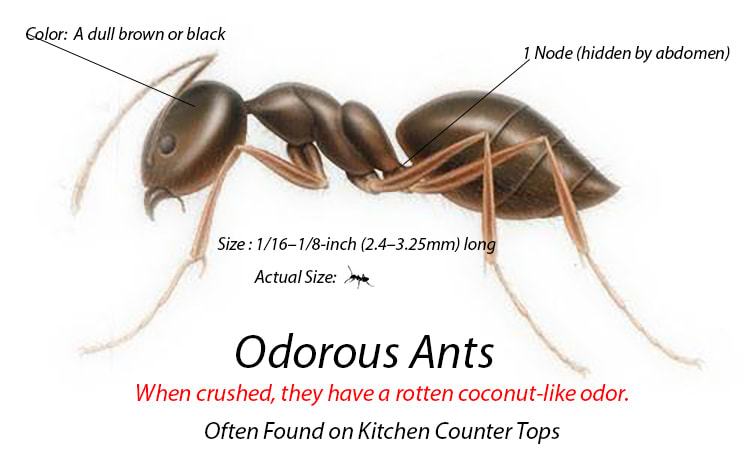
Appearance
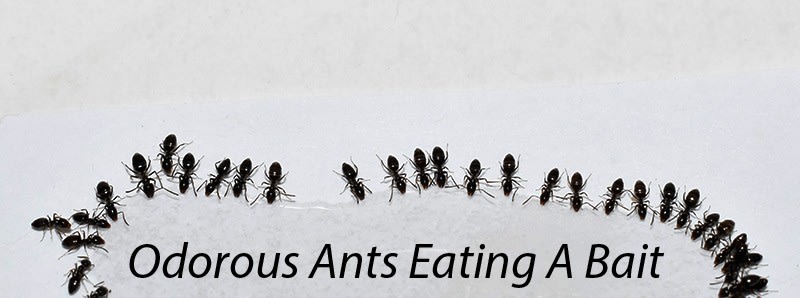
The workers are about 1/16‐1/8‐inch (2.4‐3.25mm) long. The body is brown to black in color. The antennae have 12 segments.
Inspection
Ant Trails: Odorous ants, as well as other ants, lay down a chemical trail of pheromones. Ant trails occur between nest sites and food sources. When baiting, it is important to look for their trails and place the bait there. They forage day and night. Workers forage along established trails. Look for their trails and possible nest sites.
Nests: The nests can occur in a great variety of situations. Inside, these ants usually construct their nests in wall voids, especially around hot water pipes and heaters, in crevices, sinks, cupboards, etc. Outside they are found in exposed soil, usually shallow, often located beneath a board, brick, stone walk, etc. They form nests in cavities of trees and loose bark. Nests can be found in bird nests and animal nests. They also like to nest on top of honey bee hives for the warmth provided.
They are most likely to enter buildings when their honeydew supply or sweet supply of food is reduced by natural occurrences such as rainy weather or autumn leaf fall.
Identification and Inspection
Diet
They can feed on anything such as insects, honeydew, seeds, and plant secretions, but do prefer sweets. They are extremely fond of honeydew and attend such honeydew-excreting insects as aphids, scale insects, and mealybugs.
Geopraphical Distribution
The Odorous ant is found throughout the USA. It is a significant ant in California but is less frequent in southern California in areas populated by Argentine ants. They are also found on the coasts of Oregon and Washington and the mid-south region of the US in northern Mississippi, west Tennessee, and Arkansas. This ant will also occasionally be found in structures throughout the Midwest.
Insecticide Usage and Ant Bait
Treat the exterior perimeter with a non‐repellent insecticide like Navigator SC. Spray a coarse mist of Navigator SC around the base of the foundation. Spray a foot up the wall and a foot out from the wall, an 18-inch band. Also, treat around all windows, doors, and plumbing, utility penetrations, and along any visible ant trails. It can't be detected, so they crawl through it and unknowingly track it back to the nest and queen, killing all.
We recommend using ant baits indoors, especially in cold weather, where ants won't travel outside as often. A gel bait like Optigard Ant Bait Gel is very effective.
Unless you use a non-repellent spray such as Navigator SC , baiting is the preferred treatment over typical residual spraying of repellent insecticides. Baiting is the most reliable way to eliminate the entire colony. When choosing Ant baits, it is best to choose from both the sugar‐based baits and protein/grease-based baits. If using a spray, choose a non‐repellent type unless you are treating the nest itself.
Spraying for Odorous Ants with Non-Repellents-Outside and Inside
The best insecticides for Odorous Ant control are non-repellent insecticides such as FUSE Insecticide or Taurus SC. You would spray on the outside with Taurus around the perimeter. Usually, spraying the perimeter is enough treatment for Odorous Ants, as they will go outside.
If you need any insecticide inside, use Spectre PS or Phantom Aerosol in cracks and crevices. Non-Repellent insecticides are best for ants and termites because these insects can not detect it and will not try to escape the insecticide. Non-repellent insecticides can't be smelled, tasted, or even felt by Odorous Ants.
Another advantage of using a non-repellent insecticide such as Taurus or Phantom for Odorous Ant control is that you can use ant baits near it. Repellent insecticides do not combine well with insect baits because they contaminate the lures inside the baits; that is not the case with non-repellents. The kit called, Non-Repellent Ant Kit combines Taurus SC for the Outside and Sprectre PS for the inside.
How to Get Rid of Odorous Ants
Key Takeaway
Avoid splitting the colony and making the problem worse by using only non-repellent sprays and baits for Odorous House Ant control.
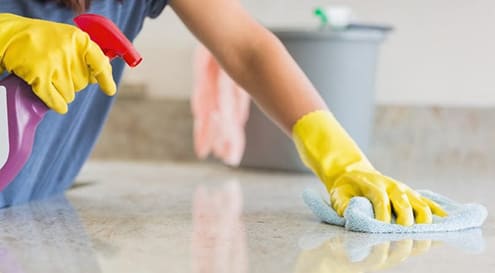
- Remove any grease or crumbs and wipe down counters and kitchen floor.
- Remove pet food.
- Move woodpiles away from exterior walls and seal up any cracks and crevices.
- Trim branches or trees that may be touching your house, so they don't use them as a highway into your home.
- Since these ants are attracted to water, fix any leaky faucet or moisture problems.
Recommended Odorous Ant Baits (Sweet and Protein/Grease Feeding Cycles)
Why Ant Bait?
The use of residual sprays or dusts (not non-repellent insecticides) causes stress in the ant colonies, causing them to split into sub-colonies and scatter. This scattering, also called budding, multiplies the Ant colonies' number and thereby multiplies your ant problem.
When you bait, use a slow-acting bait. Quick-kill insecticides and baits will only kill the foraging ants, not allowing those worker Ants to take the bait back home to feed the queen, nest workers, and brood.
If the ant bait you are currently using is not effective (if the ants are not visiting the bait), you will need to change the bait.
Slow‐acting baits provide a variety of the foods the ants find in nature. Examples are other insects (proteins/grease-based baits), nectar, aphid honeydew, and plant products (sugar and carbohydrates found in sweet-based baits).
Choosing a bait requires an understanding of the nutritional needs of the colony. To be sure that you have all the baiting needs met, you may want to be ready with a sugar/carbohydrate-based bait, a grease/fat‐based bait, and a protein-based bait.
IMPORTANT NOTE: REMOVE ALL OTHER FOOD COMPETITION WHEN BAITING AND LEAVE THE BAIT ALONE ONCE THE ANTS START FEEDING ON IT.